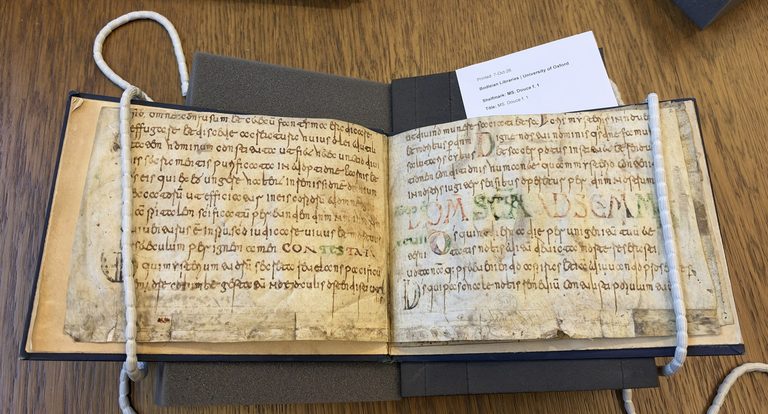
By Isidor Acton, MSt student in Medieval French (2026). The header image feature MS Douce f.1
This week, we assembled in the Weston Library for the second instalment of our crash-course in palaeography with Dr Laure Miolo, who encouraged us to adopt an all-encompassing approach to reconstructing the history of each book we encounter.
We began by learning about the various ways scribes ensured that quires were bound, and folios folded, in the correct order. We were also introduced to the pecia system, active in Paris, Bologna and Oxford from the 12th century, which enabled core scholarly textbooks to be produced affordably and en masse, with individual quires available for rent by students, who would subsequently make their own copies, or—should they be so lucky—pay a scribe to produce a copy for them. We also saw why copying folios for personal use was so crucial, examining photographs of codices whose bindings still bear traces of the chains which once guaranteed their manacled, “reference only” status. These ideas are to be borne in mind, as examples of the wealth of clues offered up to us by every manuscript, before so much as glancing at the text itself! Thus armed, we hoped to avoid getting our quires crossed as we moved on to 1,000 years of scripts…
Dr. Miolo began by introducing the ‘Roman inheritance’, Ancient Roman scripts being the direct ancestor of all medieval scripts which use the Latin alphabet. Monumental and capitalis, at the deluxe end of the Latin script spectrum, were used throughout the middle ages for headings and titles. We charted the decline of Latin as a spoken language, its use shifting to that of a scholarly language which is learned and written. For ease of reading, this led to the abandonment of scripta continua (wherethetexthasnospacemarks!), with English and Irish monks in the late 7th century being the first to use word spacing. The informal, or ‘cursive’ Roman scripts, such as those seen in graffiti at Pompeii, developed into a wide range of scripts across Europe, largely originating in monastic settings. From the late 8th century, these were gradually replaced by Caroline minuscule, with the aim of ensuring the consistency and mutual intelligibility of ecclesiastical texts across Christian Europe.
We then took a break from the theory to examine three manuscripts from the Bodleian collection, each of which captures a different stage in the development of European script. Dr. Miolo first introduced us to the MS Douce f. 1, which was written by a female scribe at the Benedictine nunnery at Chelles in the 8th century and later incorporated into the flyleaf of a 15th century text printed at Strasbourg. The script was identifiable as pre-Caroline minuscule, with particularly distinctive features including the lowercase ‘a’ resembling ‘cc’ and the ‘b’ more looking, at first glance, like a modern ‘t’, with a low, straight crossbar. It was fascinating to imagine this text being recycled to protect an early printed book, before it was deemed to hold historical significance.
Next, we examined MS. Laud. Lat. 102, a copy of the Gospels produced in Fulda, an important Insular mission in Germany, dating from the early ninth century. The manuscript was particularly notable for its elaborately decorated architectural columns in the Eusebian canon tables (concordance tables identifying parallel passages across the Gospels), as well as its use of both Insular and pre-Caroline minuscule scripts, showing the collaboration of two scribes. This allowed us to compare Insular minuscule with continental pre-Caroline minuscule, observing distinctive features of Insular script, such as the flat-topped ‘g’, alongside forms in continental handwriting that anticipate the development of Caroline minuscule in this centre.
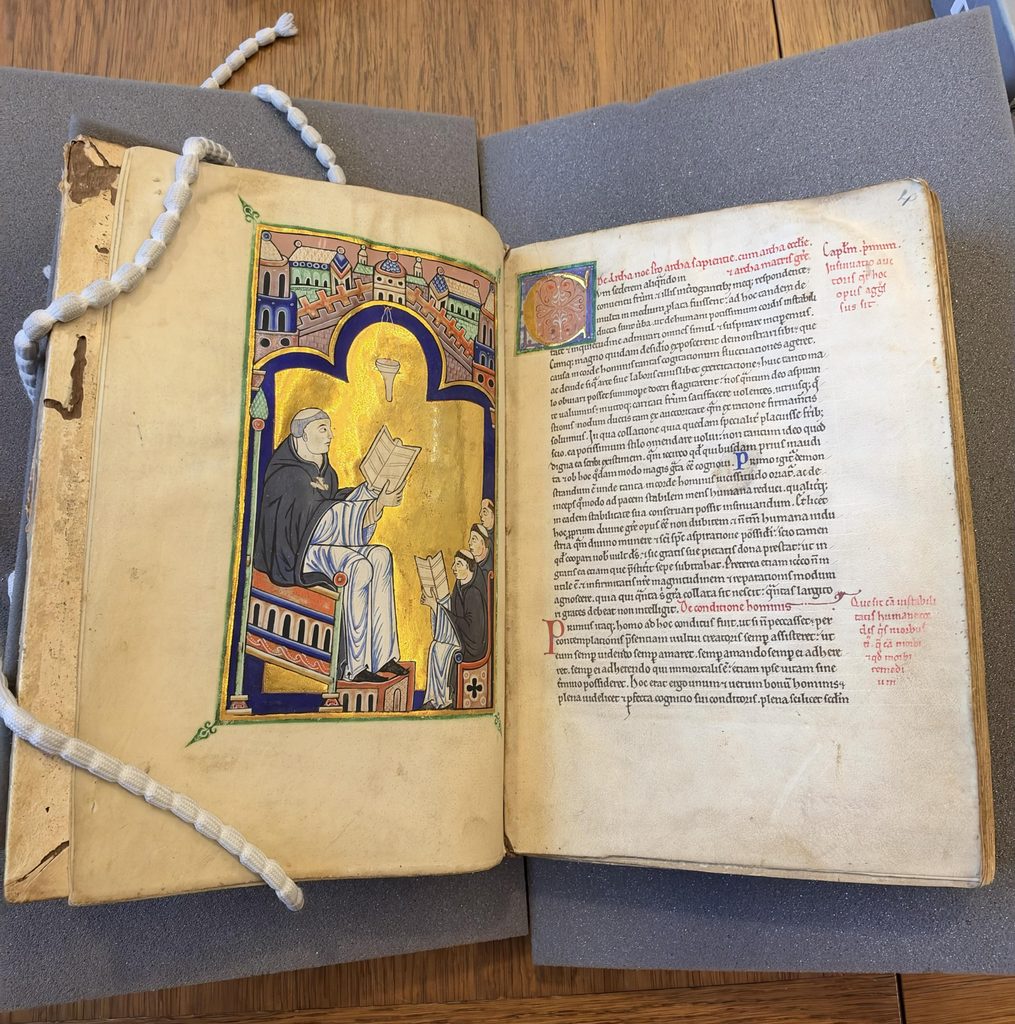
Finally, Dr. Miolo introduced us to the MS. Laud Misc. 409, a 12th century psalter produced at St. Albans. We were amazed by the illumination depicting Hugh of St. Victor teaching a group of monks, and we learned how the beautiful gold leaf is preserved from cracking by the addition of gum arabic, adhering it to the page. This manuscript, from the second half of the 12th century, is written in a protogothic script that shows marked changes from the style of the Caroline minuscule. The forms of the letters are more angular, and the script is denser and highly constructed, meaning it is formed with many pen lifts.
Returning to our potted history of scripts, we finally learned how the 15th century saw the emergence of the humanistic minuscule, modelled on the style of 11th century Caroline minuscule scripts. This reflected an aesthetic and ideological campaign to ‘purify’ patristic and classical texts, and move away from the ligatures and extensive abbreviations of many gothic scripts, simplifying the reading process and embodying the values of the ‘Renaissance’.
Here, our session came to an end, and we crowded once again around the manuscripts to catch another glimpse of their 1,300 years of history. We are very grateful to Dr Miolo for sharing her expertise, and are excited to apply our newfound knowledge to a wide variety of books and book-adjacent objects over the course of the year!