by Marina Giraudeau (Intern in Medieval German under the supervision of Henrike Lähnemann)
This week, a change of scenery: the History of the Book seminar is meeting at St Edmund Hall! After making our way into the college’s Front Quad, we are warmly welcomed by librarian James Howarth, who will be our enthusiastic guide through Teddy’s collections.
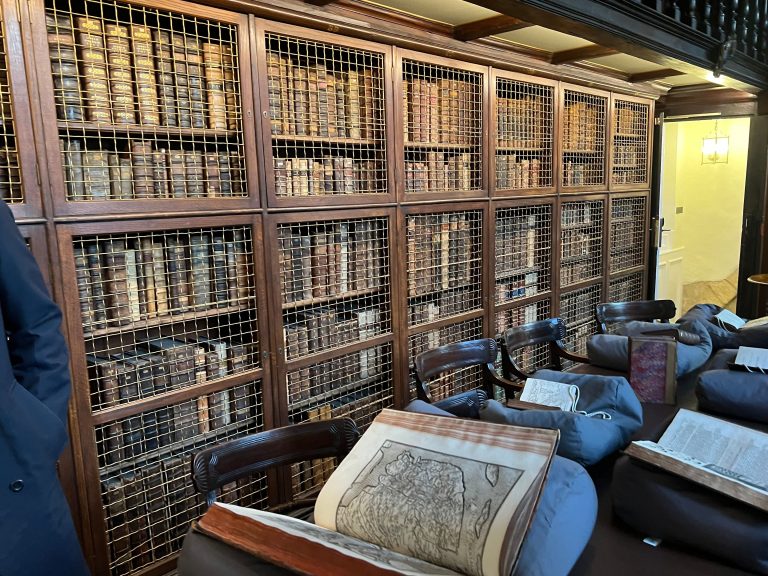
Among the ancient-looking bookshelves of the Old Library, Mr. Howarth shows us a wide variety of printed works dating from the 15th to the 20th century, and introduces us to the management of his library. Dedicated to students, the collections seek to represent the disciplines taught at the college. Thus, alongside academic works on the English language, such as Samuel Johnson’s Dictionary of the English Language, are treatises on magic, witnesses of ancient superstitions, such as A System of Magick; or the Story of the Black Art. The diversity of the books on display tells us that the Old Library is far from being an institution frozen in time. It is actually a dynamic and vibrant place, as the new acquisitions made each year and the exhibitions and other events organised there demonstrate.
Items shown in video 1:
- Salvien of Marseille, De gubernatione Dei (Paris, 1608) [Uncatalogued]
- Eikōn basilikē. Vel Imago regis Caroli, in illis suis ærumnis et solitudine ([London. 1649) [uncatalogued donation]
- Samuel Johnson, Dictionary of the English Language (London, 1799) [uncatalogued donation]
Items shown in video 2:
- Asser, Annales Rerum Gestarum Aelfredi Magni (Oxford, 1722) [Uncatalogued]
- Edmund Gunther, The Works of that famous mathematician Mr. Edmund Gunter (London, 1673) [Uncatalogued]
- David Hockney, Martha’s Vineyard and other places (London, 1985) [uncatalogued donation]
- Angela Carter, Love: a novel (London, 1971) [uncatalogued donation]
- Edy Legrand, Macao et Cosmage ou l’expérience du bonheur (Paris, 1919) [uncatalogued donation]
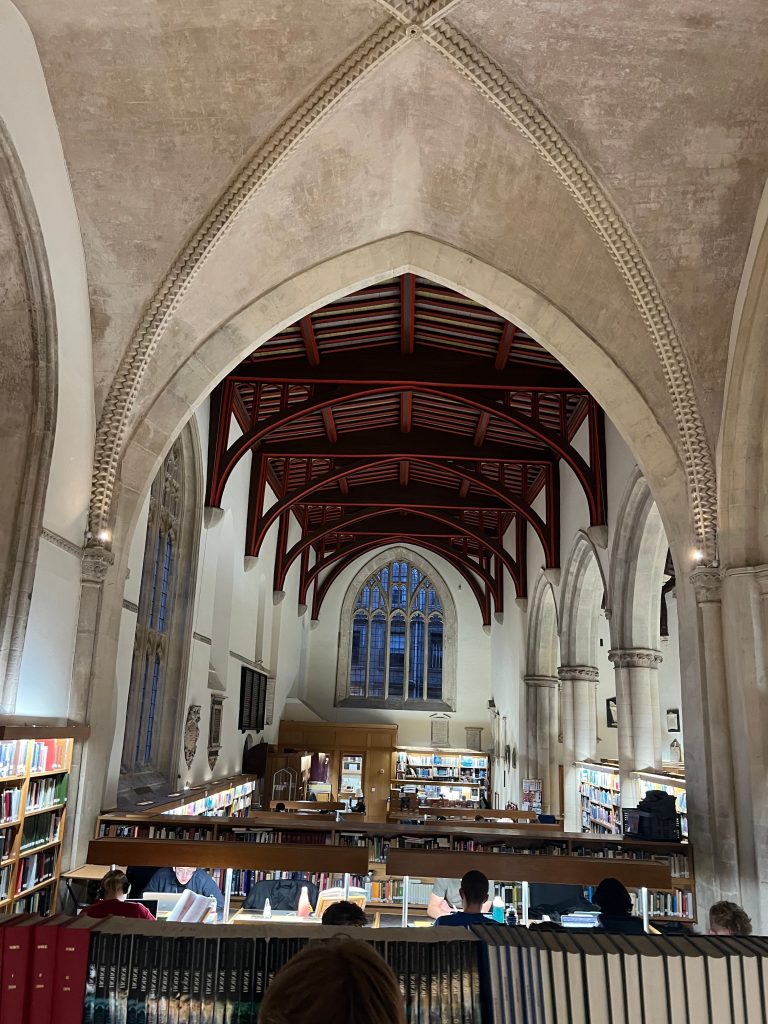
Our tour then takes us to the Library, housed in a magnificent 12th-century church. As we climb the steps to the top of the tower, some of the 40,000 books stored here are revealed, along with other aspects of the librarian’s profession. The latter must in particular deal with the constraints of the location and the history of the institution. On the one hand, he ensures that conservation standards are met by regulating humidity levels and reducing the books’ exposure to UV rays. On the other hand, he continues to add to the institution’s collections. In the case of St Edmund Hall, Mr Howarth and his two colleagues are seeking to collect books studied or written by former students of the college. These challenges and specificities constitute the identity of the Library and are part of its charm!
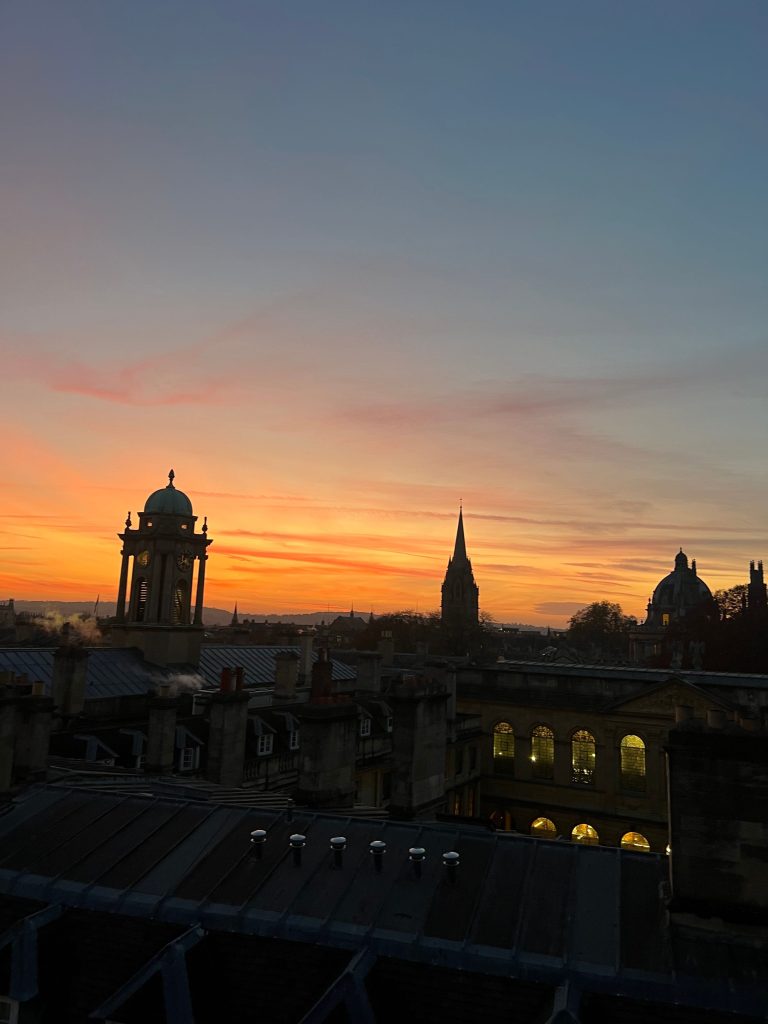
Before closing our session, we had the opportunity to ask Mr. Howarth questions about his library’s collaboration with the Bodleian Library, accessibility of collections for all, or library internships offered by St Edmund Hall. When Henrike Lähnemann, the seminar organiser, asked us why it is still relevant to buy books in the digital age, given that they can be consulted online, the answers came thick and fast. Concrete examples came to mind: some works should be considered for what they offer beyond the text, particularly through the annotations in ancient manuscripts and original drawings inserted into editions; others must be considered in their materiality, such as the illustrations on fold-out pages contained in Robert Hooke’s scientific collection. Yet, from the top of the Library tower, the sun is already setting…
As we leave the library, our eyes are still filled with wonder at the places and books we have been fortunate enough to see, and we would like to thank Mr. Howarth once again for his introduction to library management!