by Solveig Laubinger
My one-month internship with Henrike Lähnemann at Oxford University, starting in the fourth week of Hilary Term 2026, can best be described as a whirlwind of experiences. I arrived on a cold February evening, marvelling at the warmly lit alleys and grand colleges I had seen in countless movies, as I walked to St Edmund Hall for Evensong. Afterwards, Henrike Lähnemann immediately invited me to Formal Dinner, for which I was utterly unprepared. Thankfully, I was able to borrow a dress from Henrike’s impressive collection of formal outfits and enjoy excellent food and conversation.
Novels, Writings and Quotes
So much for my fantastic first impression of Oxford. My actual research goal was the transcription and digitalisation of the novel Deutsche Liebe (“German Love”) by Friedrich Max Müller, the first professor of comparative philology in Oxford, for a volume with the Taylor Editions, to be published by Henrike Lähnemann and Christina Ostermann. During my journey, I had read the 189-page novel, which was first published anonymously in 1857, and describes the love of the first-person narrator, an educated middle-class German man, for Maria, the sickly and saintly daughter of a prince. A considerable part of the novel consists of quotations from famous poems and theological texts, which the couple discuss.
I therefore wondered whether I might find something in the collection of writings and personal correspondence held by the Bodleian Library on Müller and his wife that could shed light on his inspirations for the novel and the sources of his quotations. After gaining admission to the Weston Library as a visiting scholar, I was finally able to begin reviewing materials from the Müller collection. To my disappointment, an initial survey of the letters and writings yielded no useful information about the writing process of Deutsche Liebe. Nonetheless, I catalogued all works mentioned in the novel for further research, hoping to later identify the editions Müller had used for his quotations.
The Wonders of Technology
As a diversion from deciphering handwritten materials, I turned my attention to digitising the first edition of the novel in eScriptorium, a process unfamiliar to me up to that point. The Digital Editions course at the Taylorian therefore came at the perfect time, allowing me to learn more about data and metadata. In addition presentations by students of the History of the Book Method Option provided valuable insight into similar projects. I was especially inspired by the individuality of each project and the enthusiasm with which they were presented.
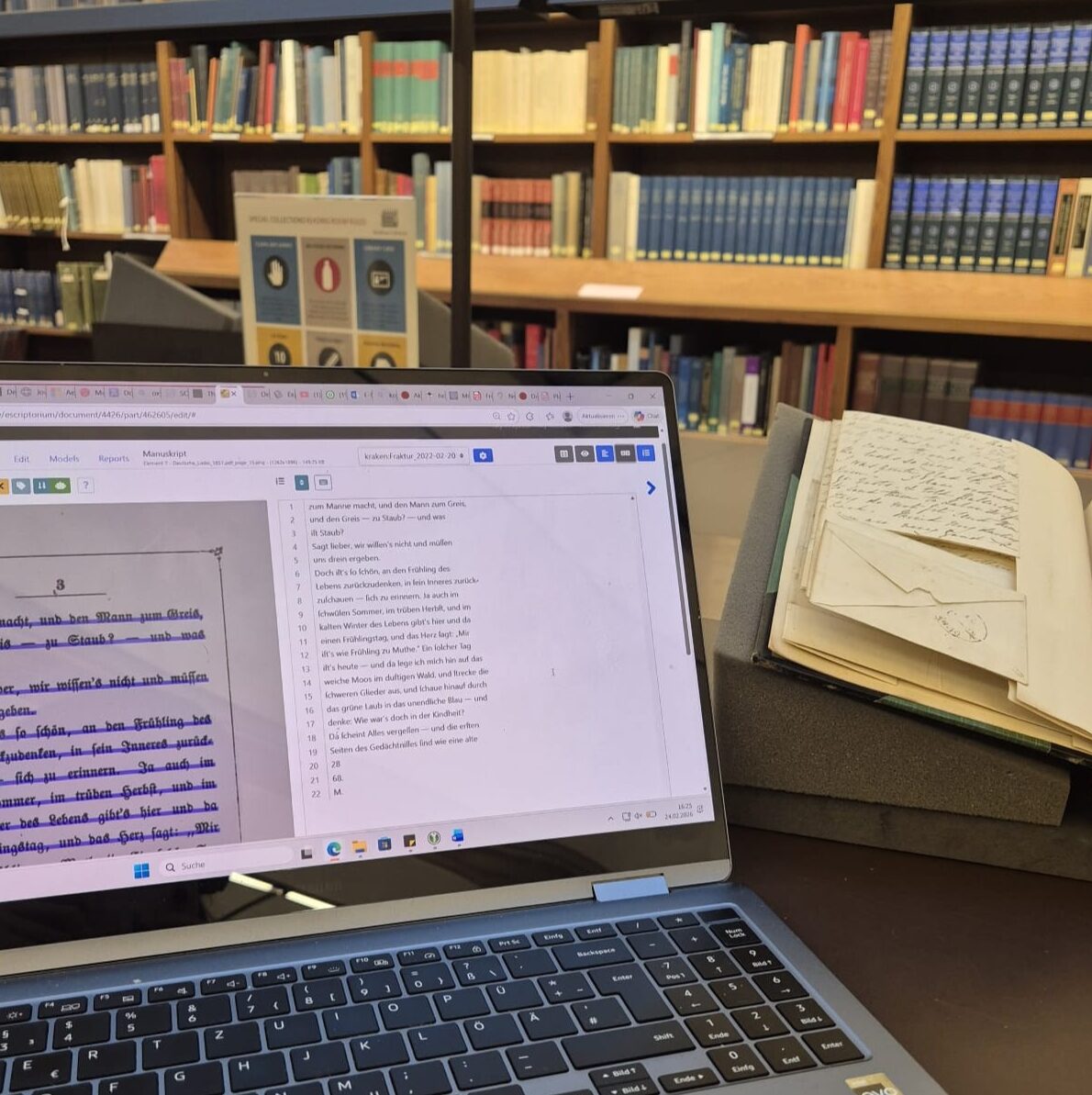
Although I had never worked with OCR/HTR software, I found numerous people willing to help me within a short time, offering introductions to the programme. After selecting and retraining an appropriate language-recognition model for Fraktur, the typeface in which the novel was printed, the transcription achieved an accuracy of 99%, leaving only a few errors to correct. I then formatted the text in Microsoft Word for the edition published by Henrike Lähnemann and Christina Ostermeier.
Beyond the project itself, Henrike encouraged me to attend seminars and connect with students and faculty. The medieval history seminar on Monday evenings at All Souls College quickly became one of my favourite routines, as did the Medieval German Graduate Seminar, where I met many wonderful people.
New Discoveries
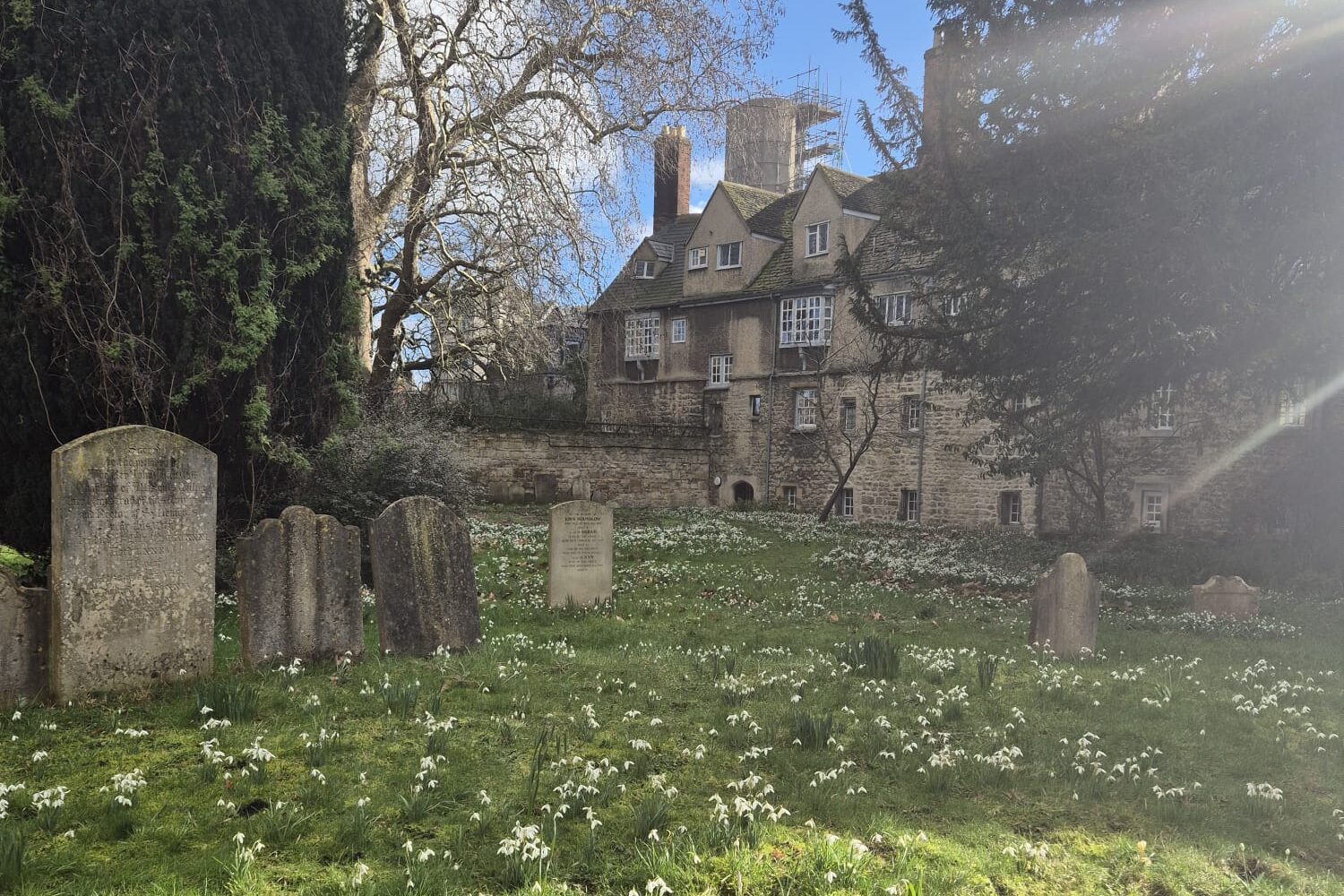
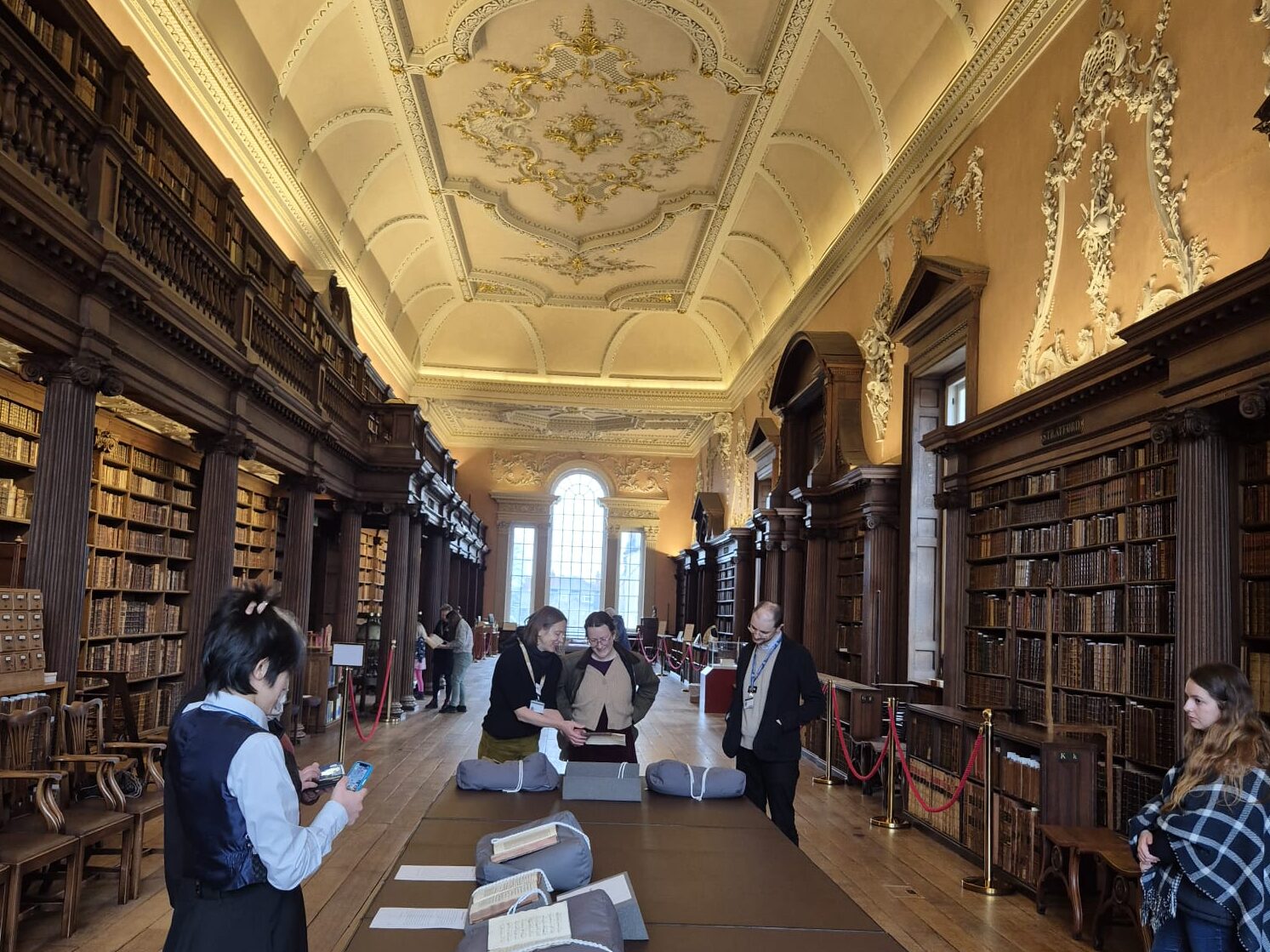
One of the most fascinating aspects of Oxford for me was its encouragement of exploration. The university is brimming with possibilities, and I often felt that something extraordinary could be discovered behind every door. From book exhibitions in the beautiful Upper Library of Christ Church College, where we even discovered hidden text in one of the books, to an exclusive tour of Sotheby’s warehouses in London, where we viewed medieval manuscripts, seeing a large collection of Käthe Kollwitz works displayed behind an unassuming door in an Oxford home. Scholars and students discussing their projects would readily admit that they were not always certain where their research would lead, but were guided by curiosity and openness. This spirit extended beyond academia into everyday life in Oxford. For example, one should not miss the church services, regardless of religious convictions. I assisted several times as a chapel clerk for Evensong at St Edmund Hall, where I connected with visitors and members of the Hall and became part of Oxford life. The Compline in the crypt, sung mainly in Latin by candlelight, was a particularly memorable experience.
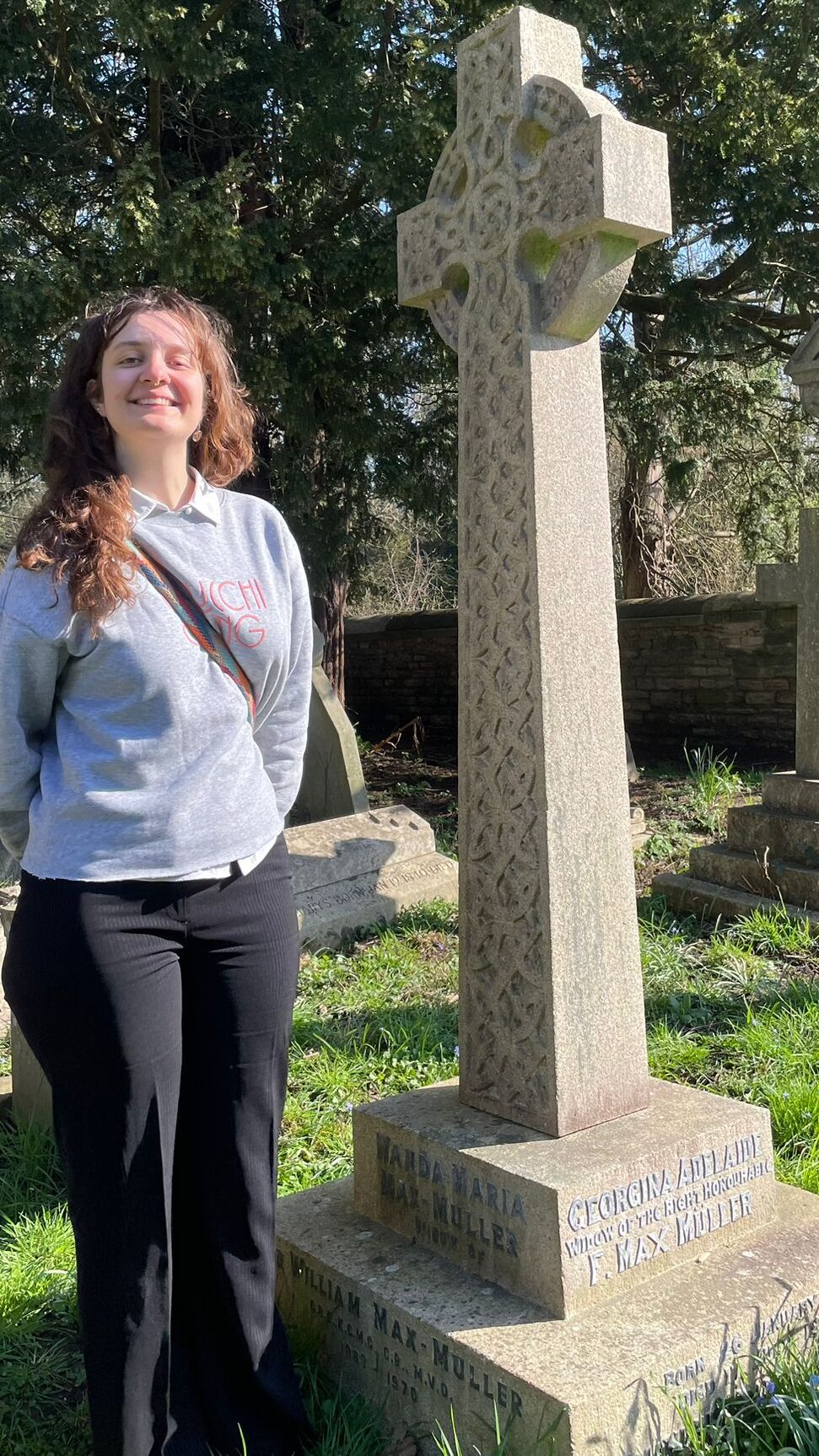
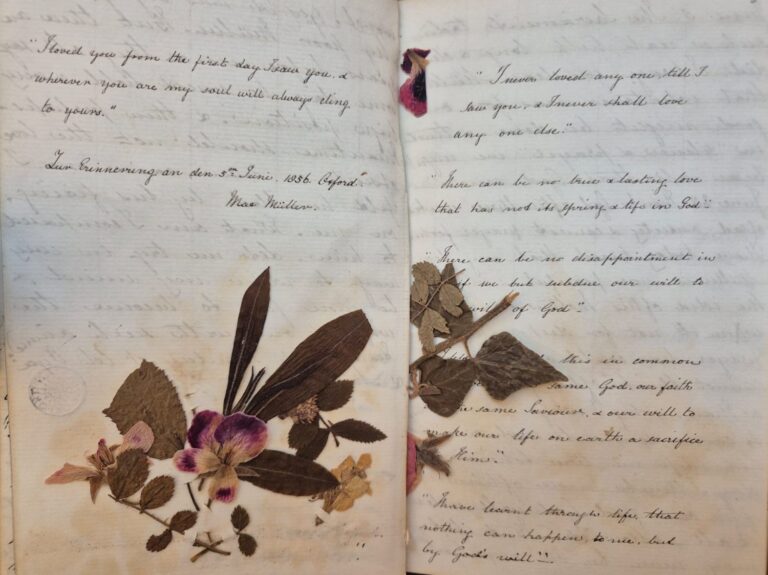
That being said, I also spent many days immersed in work, either in the library or in various cafés. In the spirit of exploration, I decided to shift my focus to Müller’s wife, Georgina Adelaide Müller (née Grenfell), after discovering a fascinating journal in which she writes about her relationship with Müller and the difficulties they faced before being allowed to marry. The text captivated me: it is written with striking honesty and vividly portrays the emotional tensions and passion of their relationship.
Because of their complex love story, there has been considerable speculation about the autobiographical elements of Deutsche Liebe. Georgina Müller, however, denied any connection and insisted that the novel was entirely fictional. Twenty years after its German publication, she translated the novel into English, although hers was not the first translation. I decided to use her translation for the digital edition. This was not only because she worked closely with her husband, but also because her personal history is intertwined with the novel, whether fictional or not.
I therefore transcribed her translation, which proved more challenging than expected, as the model initially produced less accurate results. In addition, Georgina had used the fourth German edition for her translation, whereas my work had been based on the first edition. This required me to manually match each original page to the translation, a process that demanded much patience. I also began writing a Wikipedia entry on Georgina Müller, which was another first for me. I am grateful to Henrike Lähnemann for suggesting this idea, as I hope it contributes to greater visibility of women’s roles as writers and translators.
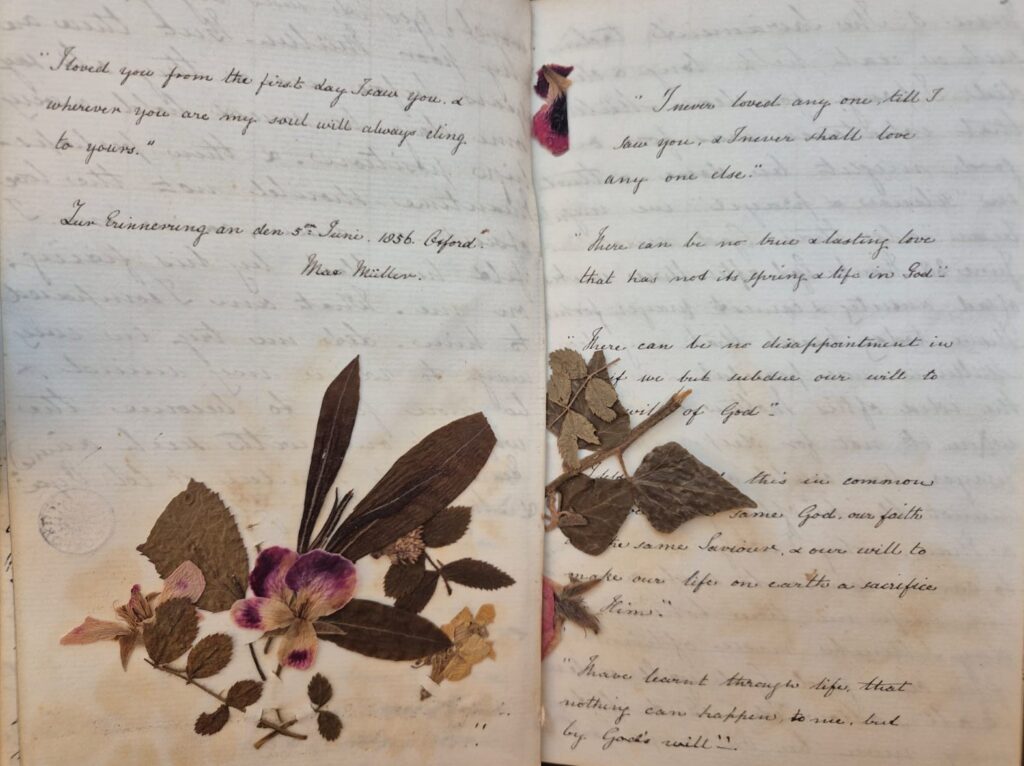
Entry by Friedrich in Georgina Müllers diary; Oxford, Bodleian Libraries, MS. Eng. e. 2714, fol. 3
Approach to Historical Subjects
Georgina Müller’s diaries revealed a fierceness that both impressed me and challenged my sense of objectivity. At times, I found myself deeply absorbed in the dramatic narrative of her journal, which was very challenging, since I was taught to disregard the person behind the historic source. A workshop with Prof. Ian Forrest (Glasgow), who posed the question of how much we perceive the person behind the documents we study and whether we should do so at all, prompted me to reflect on my approach to historical sources. Objectivity, of course, remains imperative; but I must conclude that Georgina Müller was a fascinating and strong woman, based on her journals and letters held at the Bodleian Libraries.
A Temporary Goodbye
Although I spent only four short weeks in Oxford, I learned a great deal about research, translation, digitisation, adapting a project, and exploring new possibilities. I met remarkable people who offered new perspectives and shared many moments of joy. As fascinating as my work on Deutsche Liebe was, I ultimately fell in love with the city itself, and I very much hope to return soon.
Solveig Laubinger is a BA student in History at the University of Heidelberg and spent four weeks in February / March 2026 in Oxford on a research internship in archival studies