by Leena Khabanda, MSt. Modern Languages (2026)
What is palaeography? This is the question that stood at the very centre of this seminar. Taken literally, ‘paleo’ means ancient and ‘graphy’ means writing, suggesting that palaeography means the history of writing. However, it soon becomes clear that the discipline extends far beyond the mere deciphering of old words, in fact it encompasses the reconstruction of entire cultural, physical, and linguistic contexts. Students spent the seminar unravelling this concept.
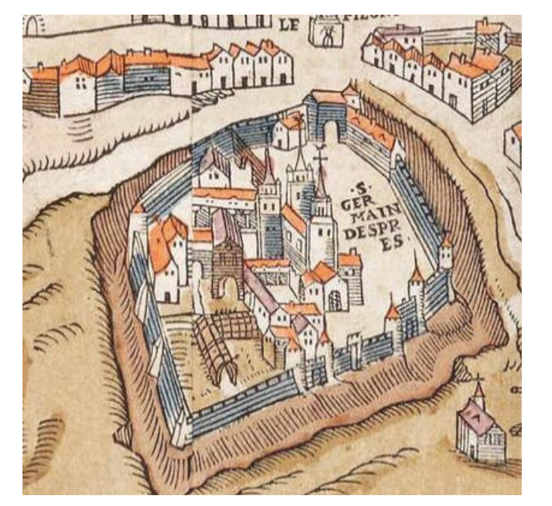
We were very lucky to have the opportunity to work with Laure Miolo, who guided us through a brief yet immersive introduction to the history of writing. We started by looking at a map of Paris by Truschet & Hoyau, published in 1553. It notably features the abbey Saint-Germain-des-Prés where the Benedictine Congregation of St Maur was established in 1621.
This abbey is historically significant, as it was here that palaeography was established as a direct defence against allegations of historical forgery when Jesuit scholars attacked the legitimacy of Benedictine charters in 1675. Given their commitment to meticulous historical scholarship at their mother house of Saint-Germain-des-Prés, the Congregation of St Maur regarded this accusation as an intellectual challenge demanding a rigorous response.
The responsibility of defending the Benedictine heritage fell to Jean Mabillon. Recognising the considerable variation in medieval handwriting across regions and periods, Mabillon undertook a systematic examination of scripts. In 1681, he published De re diplomatica at the abbey, which would lay the structural foundations for the study of Latin handwriting. Building on Mabillon’s achievements, another monk at Saint-Germain-des-Prés, Bernard de Montfaucon, applied a similar methodology to Eastern manuscripts. In 1708, he published Palaeographia Graeca.
The nineteenth century marked a pivotal turning point in the development of palaeography as a scholarly discipline. It evolved from a subordinate auxiliary science into an independent, historical discipline. This was famously pioneered by Ludwig Traube, who advocated for the study of handwriting as a cultural phenomenon rather than merely a means of legal authentication.
Bernhard Bischoff further championed this idea, viewing the medieval book as an artefact of the culture which it reveals. His book Latin Palaeography: Antiquity and the Middle Ages,published in 1979, which presents a guide to interpreting scripts from the early Middle Ages to this day remains incredibly valuable for palaeographers. Another must-read for all palaeography enthusiasts is La syntaxe du codex (2013) by Patrick Andrist, Paul Canart and Marilena Maniaci, which introduces a structural approach to studying ancient and medieval manuscripts.
Following this fascinating immersion into the history of palaeography, we were now ‘qualified’ to have a look at the manuscripts Laure had kindly brought in for us. She had also shared various tips and techniques on how to consult manuscripts, which we could immediately apply to the examples in front of us.
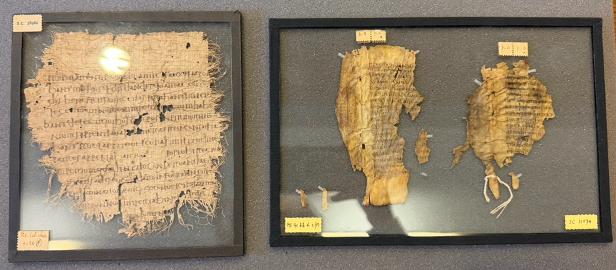
We started off by comparing a palimpsest made from parchment from 3rd century Egypt (MS. Gr. bib. d. 2 (P)) with fragments of a codex made from papyrus from 5th century Egypt (MS. Lat. class. e. 20 (P)). This allowed us to apply our newly learnt knowledge regarding the different types of writing support to real examples. By comparing ancient skins, leathers, parchment, and papyrus, we sought to determine which animal skin was most suitable for writing, ultimately identifying calfskin, particularly from the belly, as the best choice.
We then looked at a composite manuscript from the 13th Century which most likely originates from Oxford, with Robert Grosseteste’s annotations (MS. Savile 21). It has two main parts, but the individual folios come from a multitude of sources. As you look through the book, the varying sizes of its folios become apparent, making it a particularly fascinating example for the study of codicology.
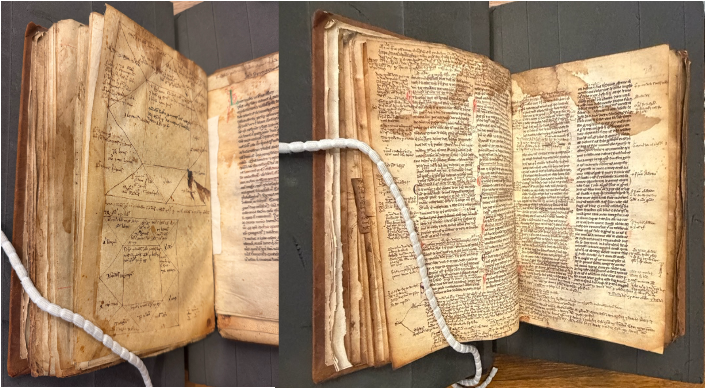
This book sheds light on the significance of the process of physically assembling a manuscript, revealing what it truly means to bring its individual components together. One folio even reveals a pin stuck to it!
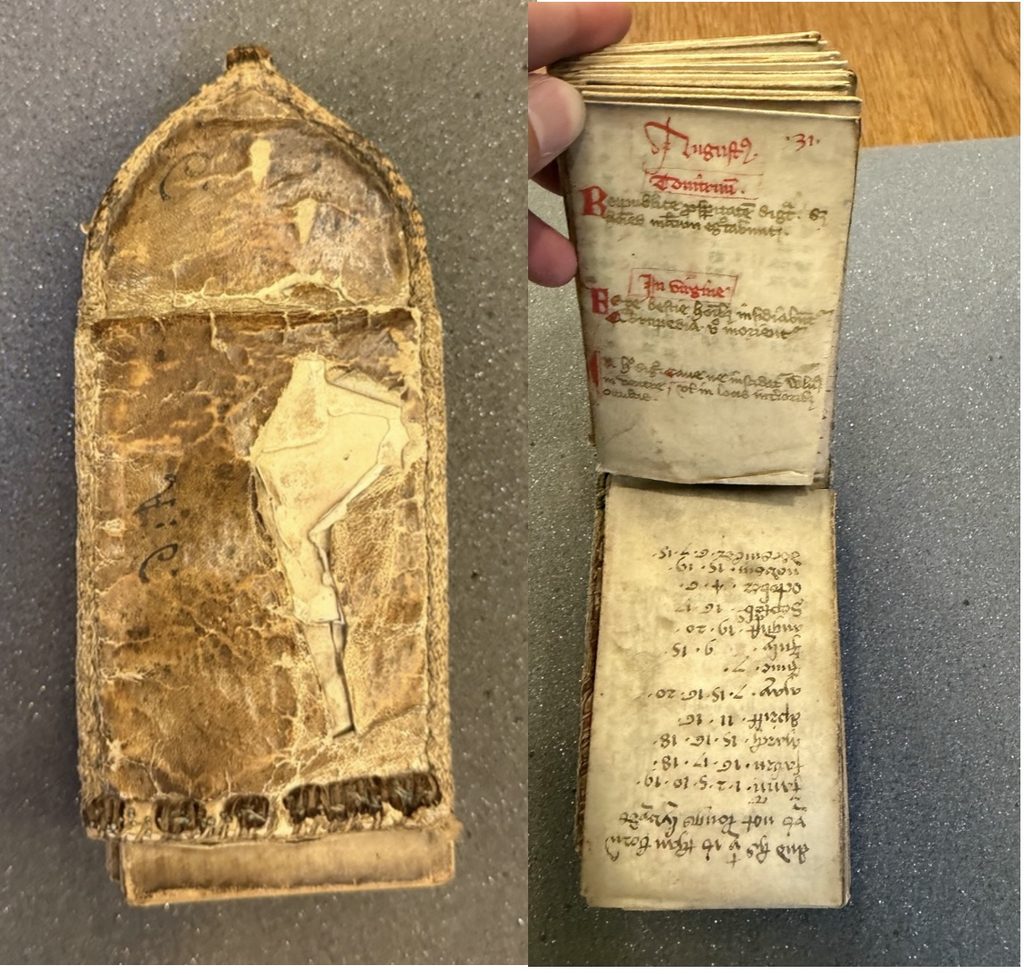
A personal favourite of mine was a 15th century English Almanach (MS. Ashmole 6). It had a looped holder of plain tawed skin, as it was designed to be worn on a chain at the belt or girdle. The book contains a calendar with astronomical and astrological notations. Each month or table is written on a piece of folded parchment, and it was highly fascinating to unfold these pieces.
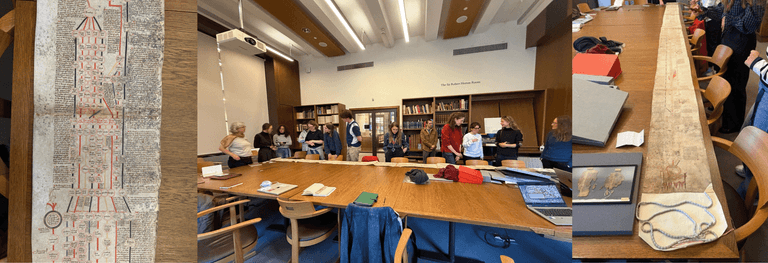
Equally exciting was unrolling a (rather long) genealogical roll of the kings of England to Henry VI that dated from the second quarter of the 15th century. From Noah to King Henry VI of England, it contains accounts of varying lengths of the persons occurring.
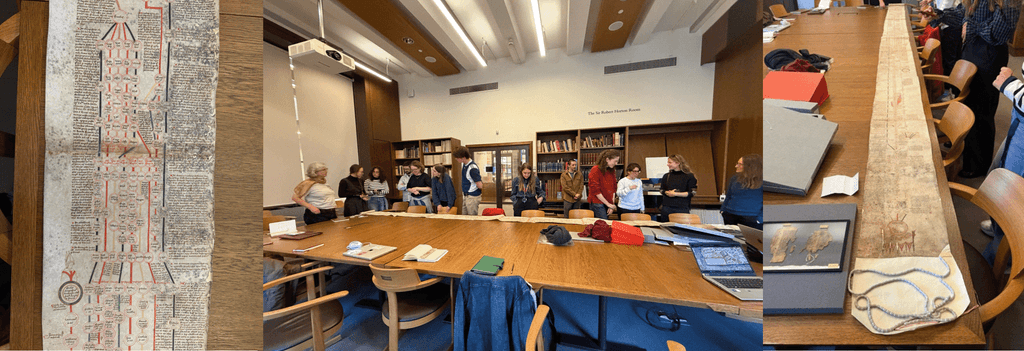
MS. Bodl. Rolls 10
This was part one of a total of two palaeography courses with Laure, and we very much look forward to the next session.