by Lanyue (Alice) Zhang, MPhil. Modern Languages 2025
During the first two terms of my MPhil in Medieval and Modern Languages, I took Professor Henrike Lähnemann’s method option ‘Palaeography, History of the Book and Digital Humanities’ with great excitement to learn about the history and handling of manuscripts and early printed books, as well as the modern digitalisation process. As my final project of the module, I decided to make a digitised, highly diplomatic partial transcription of Bodleian Library MS Canon. Ital. 108, which is also a sequel to the previous digitalisation efforts done on the same codex. Under the supervision of Professor Elena Lombardi and guidance from Professor Laure Miolo, I transcribed Paradiso Canto 1-9 (fols. 64r-72r), which is available at “Paradiso I-IX: a digital edition” (my heartfelt thanks go to Mrs Emma Huber for her help in making it live on the Taylor Editions website), and produced the following report based on my research for the codex:
Introduction to the Project
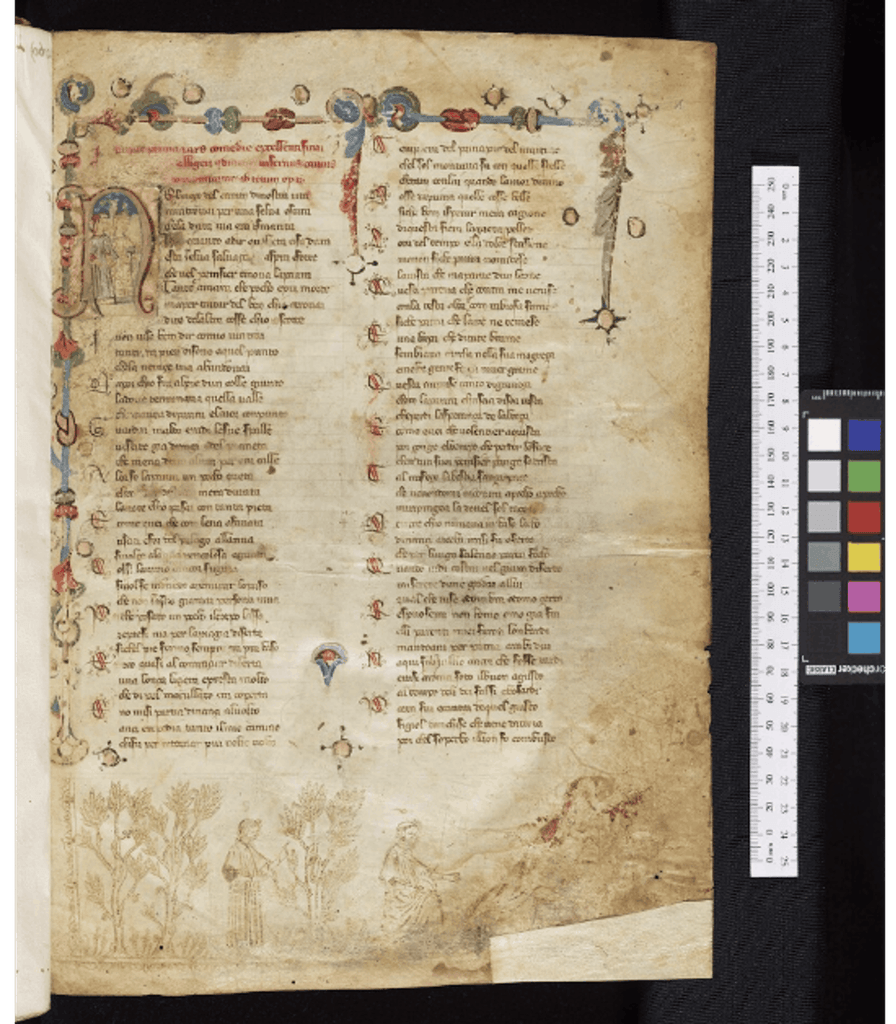
MS Canon. Ital. 108 is a complete 14th-century manuscript of Dante Alighieri’s Divine Comedy, purchased by the Bodleian Library as part of the Canonici collection in 1817. Though badly worn in many places and heavily edited, the codex is beautifully laid out and decorated with illustrations in the lower margins (Figure 1). This project’s partial transcription focuses on Paradiso canto 1-9 (fols. 64r-72r), following previous efforts that have been done on Inferno 1-9 and Purgatorio 1-9, with the latter being published. The transcriptions were done by previous students of the ‘History of the Book’ option. Katherine McKee and Thomas Godfrey have worked on Inferno 1-9 (Project report). The transcription of Purgatorio 1-9 by Katie Bastiman and Holly Abrahamson is published as Ante-Purgatory: a digital edition. More importantly, the quires of Paradiso exhibit various interesting palaeographical and textual features that deserve a closer examination for a more comprehensive understanding of the manuscript. As with previous efforts, the decision to produce a highly diplomatic edition serves to highlight and provide easier access to the scribal practices of MS Canon. Ital. 108 for anyone looking into the 14th-century textual traditions of the Comedy.
The textual tradition of the Comedy is, paradoxically, both straightforward and complex. On the one hand, a well-established and well-accepted critical edition of the text by Giorgio Petrocchi has been widely available in print and online, used as the basis for many translations and the rich scholarship on the poem. Places of major textual variances within the manuscript traditions have been extensively identified and discussed by scholars like Petrocchi and Michele Barbi (See Dante Alighieri. La Commedia secondo l’antica vulgata. Edited by Giorgio Petrocchi, A. Mondadori, 1966. Le Opere di Dante Alighieri: edizione nazionale / Società dantesca italiana 7; and Barbi, Michele. ‘Canone Di Luoghi Scelti per Lo Spoglio Dei Mss. Della Divina Commedia’. Bullettino Della Società Dantesca Italiana, 1891, pp.28–38.). On the other hand, the extant complete Comedy manuscripts are around six hundred, out of the total eight hundred transmitted copies, dating from the first half of the 14th century all the way to ‘the age of print’ (Zinelli 63, 65). Unfortunately, none of the manuscripts is an autograph, and most of them were produced after Dante’s death in 1321 (65). What comes with the Comedy’s continuous popularity and the lack of an autograph is a complex and sometimes ambiguous textual tradition that often leads to questions and debates around the text itself and its circulation. Therefore, a diplomatic transcription that treats the manuscript itself as an object and preserves its scribal practices, such as the use of allographs, variant spelling and spacing, etc, foregrounds the individuality of the manuscript and its own textual histories in connection with the larger textual traditions of the Comedy. Instead of establishing a standard text, it focuses on putting forward the significant role played by manuscript production in the poem’s early circulation.
The focus of this report comes from the interesting palaeographic and textual features observed during the transcription: the in-line presence of multiple hands, numerous traces of erasure and editing, unique but often inconsistent spelling patterns, and abundant marginal annotations. Those features actively influence the transcription process as they pose important questions, such as what to include or exclude in the transcription, and how to represent allographs of letters no longer in use today. Simultaneously, they are also traces of evidence to the manuscript’s production and circulation history. In particular, the presence of multiple hands in the text is especially worthy of discussion as it points towards a non-linear and collective production process. In addition, the examined folios share various textual variances with other manuscripts, suggesting the possibility of tracing their rough relationship and position within the genealogy of the Comedy manuscripts.
In line with these observations, this report begins with a general description of the manuscript, analysing its codicological and scribal features, then proceeds to clarify the production process of the manuscript by identifying the major hands involved in the selected folios. The section that follows attempts to shed light on the potential connections between MS. Canon Ital. 108 and other manuscripts by taking Paradiso V (fols.67v-68v) as a sample and comparing textual features across copies. I have also attached samples of the transcription and digitisation results with a short commentary on the process.
Manuscript Description
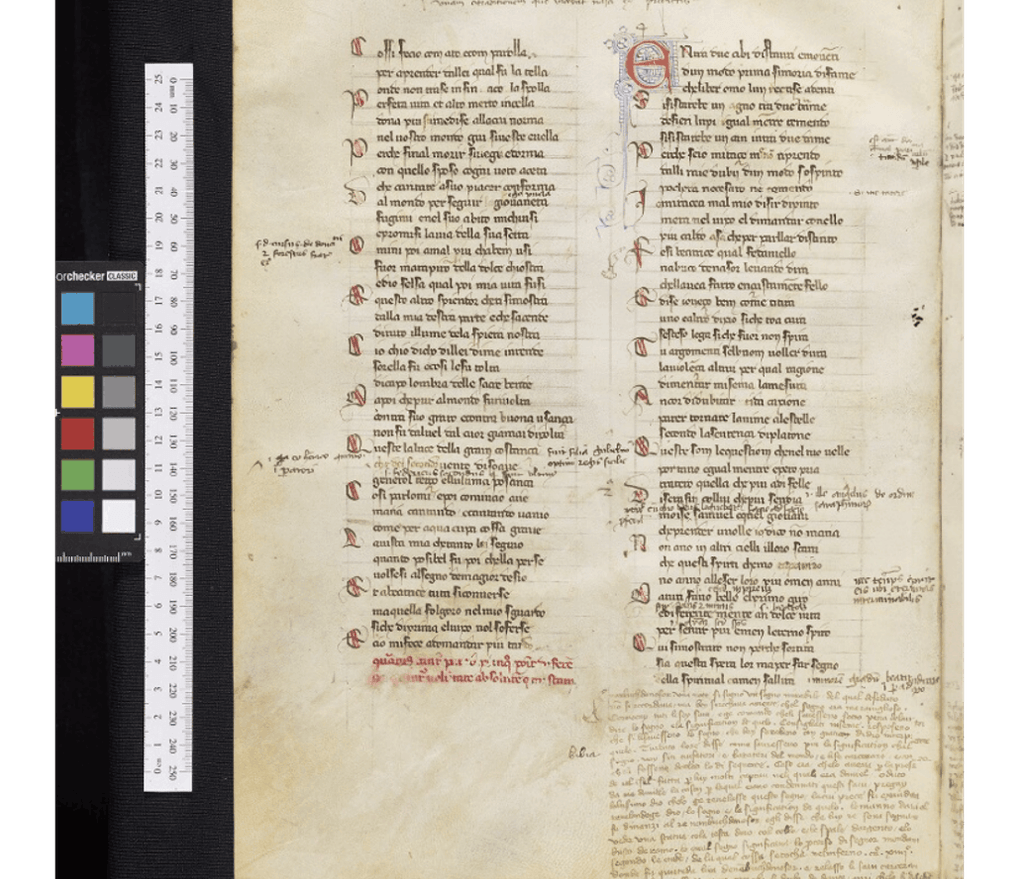
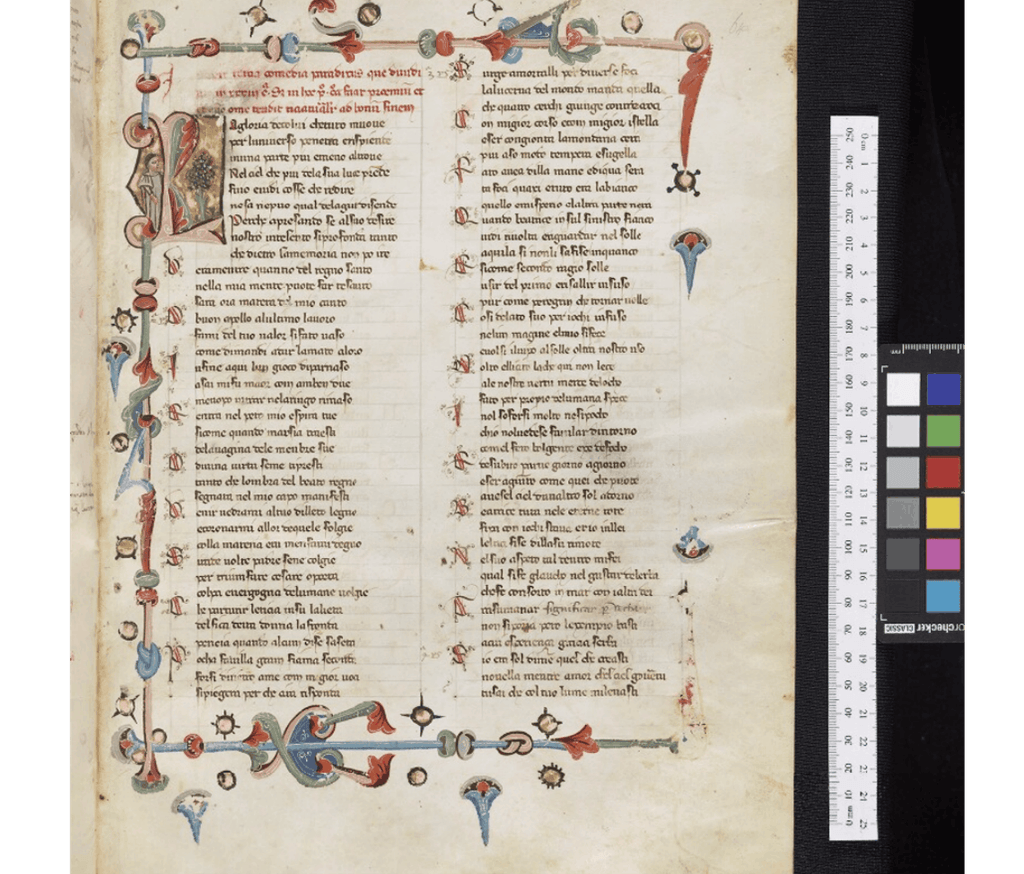
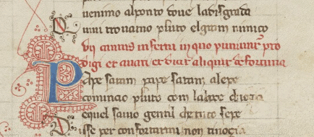
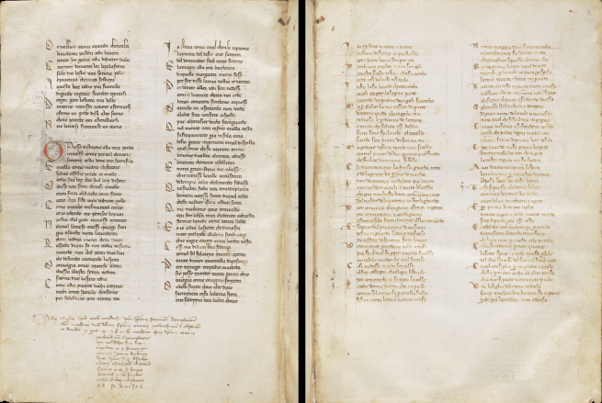
The running text of MS Canon. Ital. 108 takes up 94 folios of vellum. The verses are laid out consistently in the format of two columns per folio, and each column contains around 39 lines; traces of ruling are clearly visible in the majority of the folios (Figure 2). Decorative borders in multiple colours and large historiated initials that take up around 8 lines vertically can be found in fols. 1r, 32r and 64r, which respectively mark the beginning of each canticle: Inferno, Purgatorio and Paradiso (Figure 3). Each canticle is also preceded by a Latin rubric functioning as an incipit. The beginning of each canto is marked by a large majuscule initial with pen-flourishing, spanning across 2-3 lines. Within a canto, the first letter of each tercet is a flourished minuscule initial written – using modern typesetting terms – as a drop cap with hanging indent. Each canto is supposed to be preceded by an incipit in red ink, but the pattern becomes inconsistent from fol.10v: most following cantos do not contain the red rubric, but the space for it is already left out by the principal scribe(s) (Figures 4, Figure 5). Substantial, albeit infrequent, marginal and in-line annotations run across the entire manuscript and are written by multiple hands with different formulas of ink (e.g., Figure 2). Illustrations are found in the lower margins, though inconsistently: they appear much more concentrated in the first two-thirds of Inferno (fols. 1r-20r) and the majority of Purgatorio (fols.32r-59r), yet disappear completely after fol.59r (Pur. 30), rendering the entire Paradiso without any illustration. Several pages of the illustrations are badly eroded or even cut off; occasionally, the text is also damaged beyond the point of legibility. At the end of each canticle, we observe an explicit written two or three lines after the last verse. Unlike the incipits, the explicits are written in black ink. The explicits of Inferno and Paradiso (fols. 31v, 94v) are written in the Italian vernacular and in the same format as the verses (Figure 6). However, the explicit for Purgatorio is in Latin and without the flourished initial, but has slightly more calligraphic strokes (Figure 7).
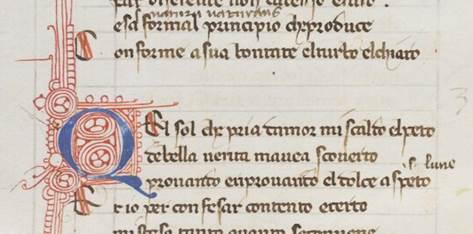
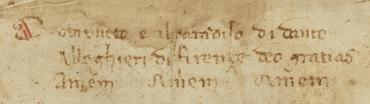
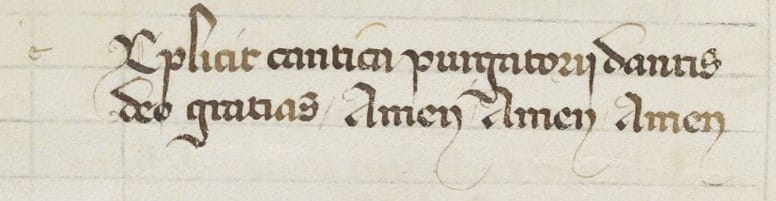
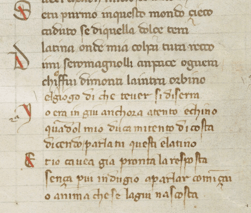
Two scribal hands have been identified for the text. A principal hand (‘Scribe 1’) copied the majority of the manuscript, but a clear change in hands can be seen at the end of 24r, with the second writing (‘Scribe 2’) experiencing a worse case of ink discolouration (Figure 8). As commented by Edward Moore, ‘the portion from Inf. xxvii. 31 to the end of Canto xxxiv. has been written by a different scribe whose writing and ink are both inferior’ (515). Scribe 1 resumes copying from the beginning of the Purgatorio. Yet it goes unmentioned by Moore that Scribe 2 also makes a return in the manuscript, as we clearly observe the same change in hands from the beginning of fol. 84v, from Par. XXII, v.64 (Figure 9), and to the end of the manuscript. It is the same hand that wrote the Paradiso explicit shown above (Figure 6) as well as the Inferno explicit, whereas the Purgatorio explicit is written by Scribe 1. The aforementioned differences between the explicits are a direct result of different scribal practices. The rubrics, on the other hand, are all by Scribe 1. It is not unusual for multiple scribes to be involved in the production of larger manuscripts, yet these rather abrupt changes of hands still raise questions about the production process of MS. Canon. Ital. 108 as to why such back-and-forths happened, which the following section attempts to clarify.
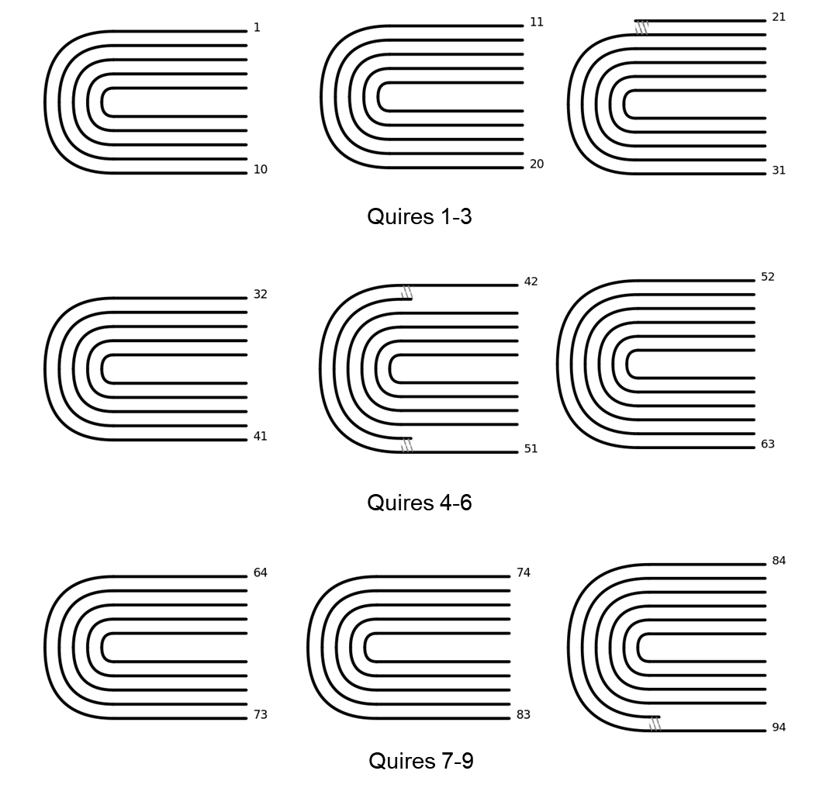
The manuscript consists of 9 quires, without any evident use of catchword or quire numbering. [There may once be quire numberings. Quire numberings are often written at the bottom corner of a folio, yet the bottom corners of the manuscript are frequently worn and repaired with a patch of parchment.] The beginning and the end of the manuscript each have two pages of flyleaves that are detached from the quires and made of early modern paper with a watermark. [Since the focus of the report is on the running text within the manuscript, the watermarks will not be discussed here.] The codex was rebound once it was acquired into the Canonici collection with its current early modern binding and the marbled pastedown characteristic of Matteo Luigi Canonici’s binder (Mitchell 113). Its structure appears as: ii+110 (fols.1-10v) – 210(fols.11-20v) – 311(fols.21-31v, 1 singleton of fol.21) – 410(fols.32-41v) – 510(fols.42-51v) – 612(fols.52-63v) – 710(fols.64-73v) – 810(fols.74-83v) – 911 (fols.84-94v, originally a quire of 12)+ii. The quires are represented in diagram form below (Figure 10). Each canticle neatly occupies 3 quires, with the cantos spread out evenly. The largely consistent quinion composition (which is common to Italian codices at the time) and the decisions to add an extra folio to the last quire of a canticle (e.g., the singleton of fol.21 in Quire 5 and the extra bifolio in Quire 6) to accommodate everything tell us that active pre-planning is involved in the production process and indicate clear intentions to maintain the structural division of 3-3-3 for the three canticles. This codicological design suggests a consciousness of the overall structure of the Comedy and the effort to correspond to it in materiality. Whether coincidentally or not, it also echoes the structural symbolic significance of the number 3 in Dante’s work in relation to both the Trinity and the terzina.[For more on the symbolism of number 3 in the Comedy, see Lansing, Richard, ‘Numerology’, Dante Encyclopedia, edited by Richard Lansing, Taylor & Francis Group, 2000, pp.653–57; Freccero, John. ‘The Significance of Terza Rima’. Dante: The Poetics of Conversion, with Rachel Jacoff, Harvard University Press, 1986, pp. 258–74.]
Script and Text
Moore describes the script of MS. Canon. Ital. 108 as a ‘semi-Gothic character and 14th century’(515). However, as Stefano Zamponi points out, the term ‘semi-Gothic’ is not adequate enough to summarise the complex diversity of Italian scripts in the 13th-16th centuries: the implied connotation that the hand is simply ‘not opposed’ to Gothic scripts does not capture the rich ‘panorama’ of Italian scripts ranging from the littera textualis and its simplified variances, to documentary cursive scripts like cancellaresca and mercantesca, and everything in between (436). [For the development of documentary cursive scripts and their evolution into a book hand, see Ceccherini, Irene. ‘Le corsive italiane tra 1270 circa e 1350 circa. cancelleresca e mercantesca’. De la herencia romana a la procesal castellana. Diez siglos de cursividad. Actas del IV Encuentro Internacional del Seminario Permanente ‘Escrituras cursivas’, Editorial Universidad de Sevilla, 2018, pp. 175–89; and Ceccherini, Irene. ‘Teaching, Function and Social Diffusion of Writing in Thirteenth- and Fourteenth-Century Florence’. Teaching Writing, Learning to Write, 2010, pp. 177–92.] It is thus proposed that when identifying a hand as a variance of the littera textualis, one should pay attention to and specify the individual details for each case (436). In light of the mixed features exhibited in the scribal hand of the selected folios, this report adopts Zamponi’s stand and examines the script more closely, bearing in mind the complex traditions of Italian book hands.
In general, the running text of fols.64r-72, written by Scribe 1, is a form of cancellaresca retaining several Gothic or textualis features. According to the diagnostic features established by Albert Derolez (142–57), the script exhibits the following cancellaresca qualities:
- Single compartment a:
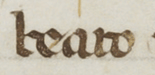
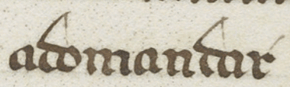
- Looped d turning to the right, often with loops on ascenders as well and generally more angular:
- Letters p, q, f and long s (transcribed as ſ ) have straight and tapered descenders extending below the baseline:
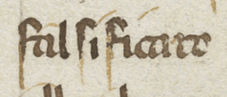
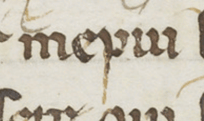
- The limb of h and the final minim of m or n extend below the baseline with a curve to the left:
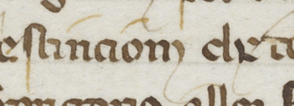
- Use of both the textualis r and the round r (transcribed as ʀ):
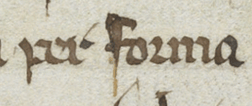
- st-ligature appears as a straight s and high t linked by a concave stroke at the top (transcribed as ſt):
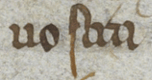
At the same time, it also retains several simplified textualis features, based on the diagnostic features summarised by Zamponi (430–32) and Derolez (103–10):
- The use of textualis m and n with a flat end on the baseline for the first minim(s), while the final minim has an oblique foot:
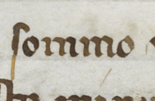
- Overlapping of contrary curves:
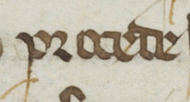
- Use of a round r after a curve, like syllables or, pr, br:
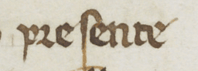
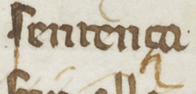
- c caduta or c with cedilla (transcribed as ç) is used to represent z or z sound:
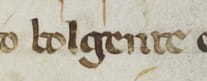
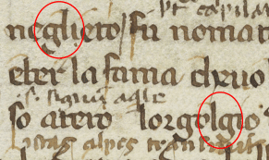
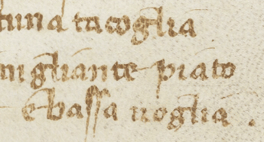
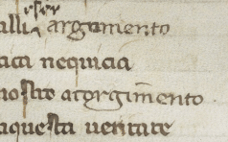
The manuscript also presents a peculiar spelling pattern, as identified by Moore: the inconsistent interchanging use of single and double consonants, which ‘prevails to a greater degree than in any other manuscripts’ examined by him; frequent omission of the definite article and the copula; interchangeable use of m and n at the end of a word, etc (516). Based on the collation, Moore classifies the manuscript as belonging to a Venetian or Lombardo-Venetian tradition (704). [The localisation of the manuscript remains ambiguous and debated. Others have identified the manuscript as of a southern origin, such as the identification currently referenced by the Bodleian catalogue (Alexander and Pächt ii.173).] In addition, one of the most consistent spelling patterns is the use of lg for the Italian syllable gli (Figure 22). The only exceptions in the principal scribal hand within fols. 64r-72r appear only in two folios (fols. 68v, 69r) and almost immediately switch back to lg as if the use of gli is a mishap (Figure 23). This spelling pattern seems to be only characteristic of Scribe 1, for Scribe 2 uses gli consistently instead of lg (Figure 24). This suggests that the use of lg is perhaps not a matter of the temporal axis but is more likely an indication of Scribe 1’s cultural background or scribal training.
Furthermore, there is a substantial amount of in-line editing by multiple hands, visibly different from the scribes. After excluding erasures without any overwriting and corrections, the total number within the selected folios still amounts to around one hundred fifty. On the other hand, in comparison to the critical edition established by Petrocchi, the running text contains over forty-seven textual variances that are not differences in spelling or spacing, or evident scribal errors like eye skips (Figure 25, Figure 26). These observations play a critical role in the development of the following discussions, which tries to clarify the production process and trace a textual genealogy with other Comedy manuscripts.


Clarifying the Production Process
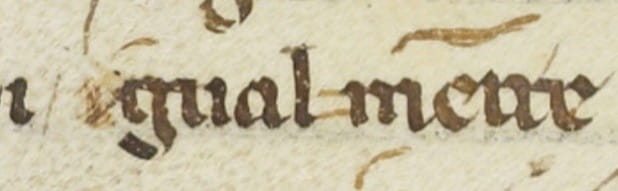
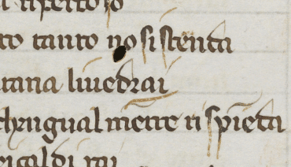
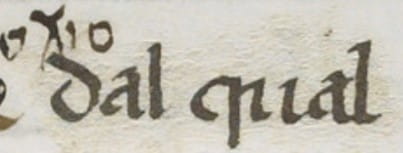
As mentioned above, fols.64r-72r are filled with edits from multiple hands visibly different from the principal hand of Scribe 1. The differences range from varied allographs of letters, pen strokes, to the use of different ink formulas, shown by various grades of discolouration (Figures 27 and 28). Overall, four different editing hands can be confidently identified, which the following discussion will explore in detail. The majority of the edits were rewritten over visible traces of erasures; some, usually single-letter or single-word additions, are squeezed in between neighbouring letters or inserted from above the line with a caret (‘∧’) below the baseline (Figure 29, Figure 30). Occasionally, an equal sign (‘=’) in a different ink is added to the single space between two words, indicating that the two connecting words should be read continuously as one (Figure 31).


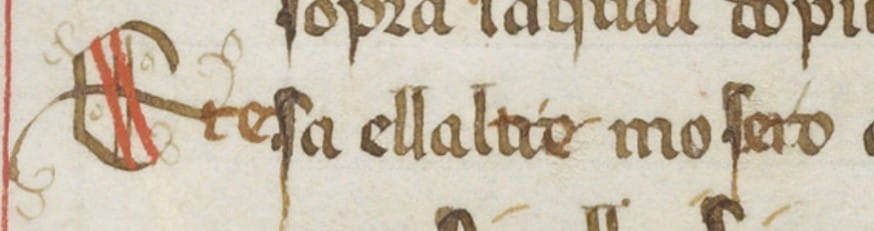
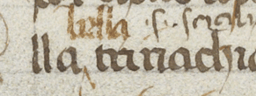
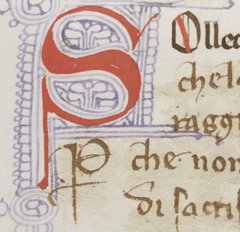
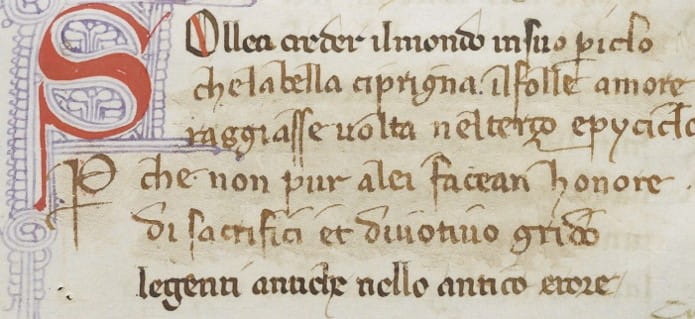
The most commonly occurring editing hand (Figure 28) appear to be a cursive script contemporary to the scribal hand. Furthermore, at the end of fol.70r, we observe a substantial four-line erasure and rewriting for the opening two tercets of Par. VIII by this main editing hand (Figure 32). Interestingly, the purple pen flourishing of the majuscule S, which usually is the last step of text production, extends over the traces of erasure without a clear breaking in stroke. The purple ink seems to run over the foot of the r and the descending loop of the second g in raggiaſſe, creating minor bleeding. It, as well as the red ink for the majuscule S, also runs over some spots in the minuscule drop cap p, yet the purple ink skips over the curved end of the abbreviation mark across p’s descender. All these suggest that at least a section of the editing, namely the ones done by the main editing hand, takes place as part of the textual production between the initial copying and the final flourishing and decorating by the illuminator(s).
Even more interestingly, the running text itself also shows traces of at least two different hands involved. The descenders of letters like long s and f are done by two separate strokes: the initial shorter stroke is in the hand of Scribe 1 in a darker ink, then another hand extends it over the baseline in a thinner stroke and a more discoloured ink (Figure 33). The same colour of ink and style of pen stroke also added diacritical marks like accents, tildes and cedillas, on top of Scribe 1’s work. Based on the level of discolouration, the ink modifying Scribe 1’s hand is largely identical to the ink used by the main editor. We also do not see long descenders broken into two strokes, or diacritics being added later in a different ink in the 4-line rewriting by the main editing hand. The use of very thin strokes for accents and the addition of a small tie to the tip of h’s ascenders (e.g., compare the h in Figure 23 and Figure 32) are also highly similar between the two hands. Although we must maintain a level of caution in identification, based on the similarities, it is more than likely that the one who modified Scribe 1’s hands and the main editor are, in fact, the same person.
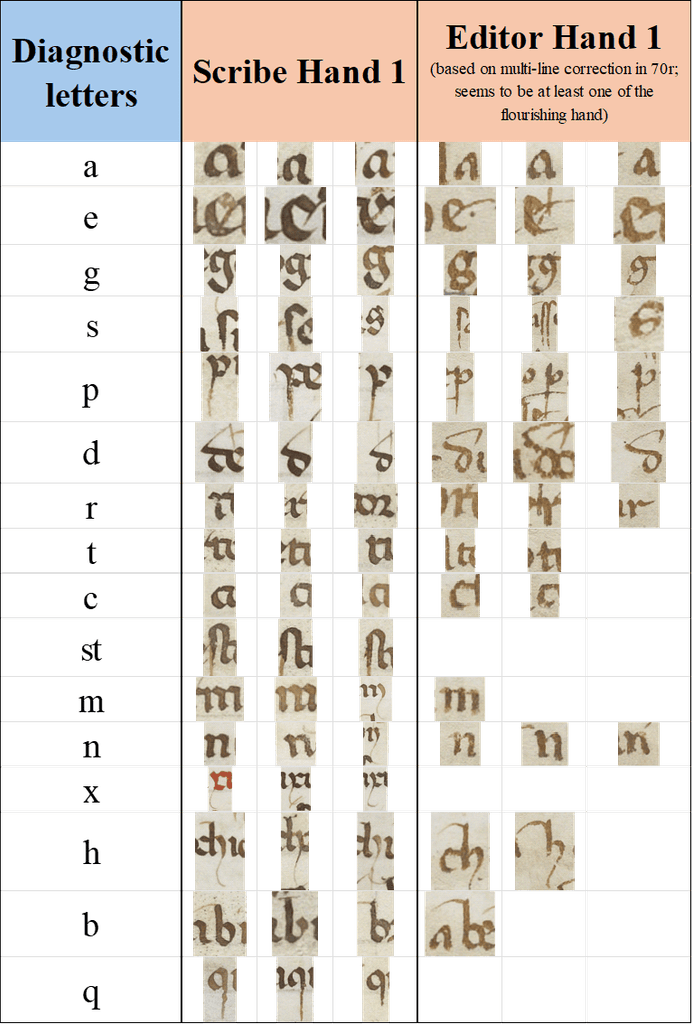
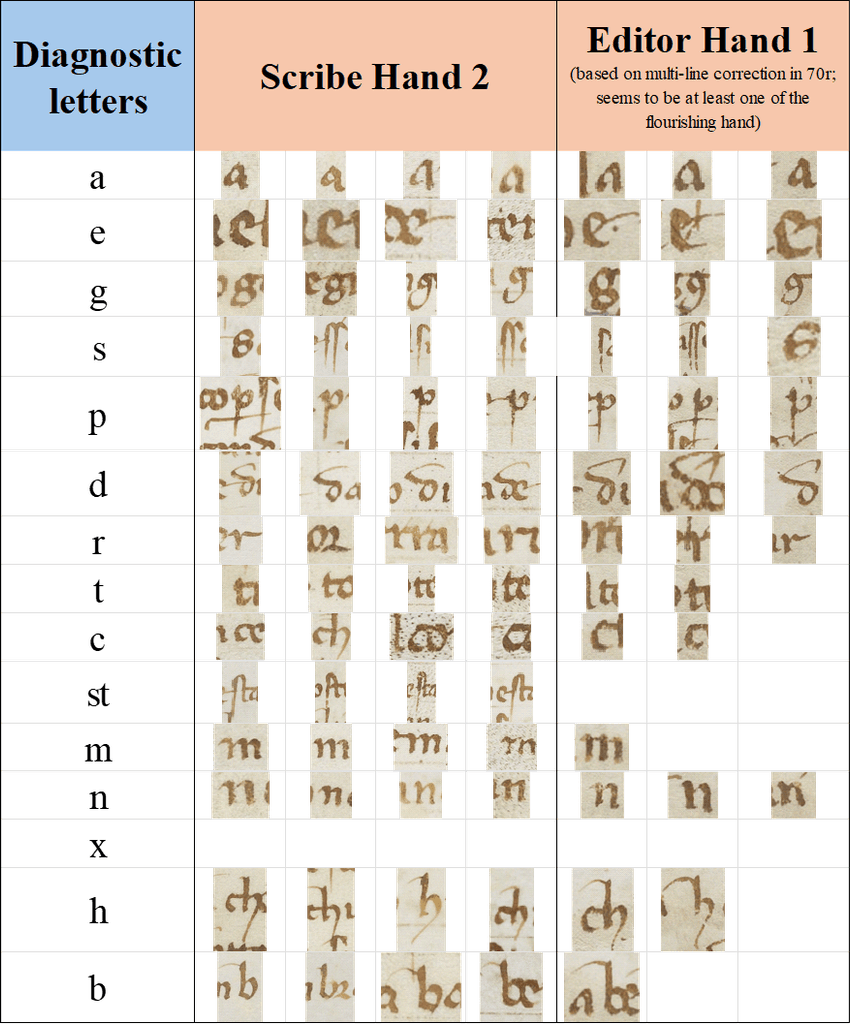
The next step is to further clarify the number of hands involved in the editing of the text. As a baseline, I established a list of diagnostic letters for Scribe 1 by selecting randomly across fols. 64r-72r, and three examples are selected for each letter. It is also straightforward enough to establish a first major editor (‘Editor Hand 1’ or ‘Editor 1’) text based on the block editing in fol.70 (Figure 34), and the same process is conducted to create a list of diagnostic letters for Editor Hand 1, which is identified as a cancellaresca script with fewer textualis features than the hand of Scribe 1. After the chart of diagnostic letters (Figure 35) is established for both hands, it is compared with a compilation of 150 in-line edits to identify other occurrences of Editor Hand 1, as well as how many other edits are substantially different and independent enough to be classified as a separate editor hand.
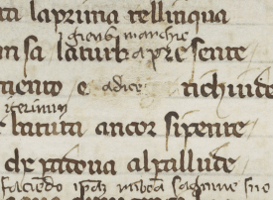
As a result, three other editor hands are identified, one of which only appears once and is the same hand as the surrounding annotations (Figure 36). Editor Hand 2 is identified based on two neighbouring corrections in fol.67r (Figure 37): the ink and pen nib used clearly appear to be a third type different from the scribal hand and Editor Hand 1; features like the use of double-compartment a, the more exaggerated looped and undulating tails of g, and more cursive forms of m and n sufficiently distinguish the hand from the scribal hand and Editor Hand 1. However, Editor Hand 2 only has two other evident appearances in fol.64r and fol.69r. Editor Hand 3 also occurs only once across the selected folio, in fol.67v, characterised by less compression horizontally and the use of uncial d (d with oblique shaft) and double-compartment a (Figure 38). Approximately over 50 edits can be confidently identified with Editor Hand 1 (like Figure 28). The rest are difficult to identify and must be treated cautiously due to reasons like they are only one or two letters, or the editing is too messy to be discerned. Nevertheless, it is safe to conclude that the dominant editing hand, namely Editor Hand 1, is actively involved in the original textual production of the manuscript. At the current point, it is hard to gauge when the other two hands start to engage with the manuscript, but this initial identification based on selected folios could serve as a partial foundation for a more extensive survey over the entire manuscript, further clarifying the production process or circulation history.
So far, the examination of the different hands appeared in fols.64r-72r has established that, before the final flourishing and decoration by the illuminator(s), there are at least two separate steps involved in the completion of the running text: the initial copying of the running texts, and then at least one major person, i.e., Editor 1, edited the text, who also modified Scribe 1’s hand with addition of extended descenders and diacritics. While I was tempted to conclude this section as is, there is more evidence beyond the confines of the selected folios that helps further clarify the relationship between Scribe 1 and Editor Hand 1. If we recall from earlier, two scribal hands are involved in copying the running text for the entire manuscript: in comparison to Scribe 1, the hand of Scribe 2 is a cancellaresca script with fewer textualis features; Scribe 2 also used a different formula of ink that has experienced more discolouration than the ink used by Scribe 1 (Figure 9). Particularly, the discolouration of the ink used by Scribe 2 is very similar to that used by our Editor 1, whose hand is also a cancellaresca script with fewer textualis features and appears very comparable to the hand of Scribe 2, with a rough evaluation across folios. Based on these general observations, it is hypothesised that Editor 1 and Scribe 2 are the same person. In verification of the hypothesis, a chart of diagnostic letters is established for Scribe 2 with examples selected randomly from the folios copied by him (Figure 39). Since Scribe 2 copied two separate sections of the manuscript (fols.24v-31v and fols. 84v-94v), for each letter, two examples are taken respectively from each section. Then, the letters are compared to the established chart of Editor Hand 1.
In conclusion, Scribe Hand 2 and Editor Hand 1 are, in fact, the same hand. As seen from Figure 39, aside from the discoloration of ink, the hand is marked by several outstanding features: the extended middle bar of e; two forms of g, a closed, 8-shaped g and an open g with a looped tail; thin and tapered long descenders extending below the base line for letters like s and p; looped d turning to the right, with loops to the left on the ascender; c with a flat top; the last limb of h extends below the baseline, yet without a curve to the left and is slanted more towards the right; addition of a small tie to the right of the ascenders of h and b, etc. The identification between Scribe 2 and Editor 1 suggests that instead of two scribes copying the text and one editor editing later, the production process should be understood more likely as Scribe 1 works on the initial copying, then for some reason Scribe 2 joins for a thorough editing that includes modifying the hand of Scribe 1, supposedly correcting his work and (re)copying substantial sections of the manuscripts before it is eventually sent to the illuminator(s) and bound into a codex.
Although it is very hard to fully clarify all the details due to the lack of evidence, and further research is required to verify any hypotheses, we can still propose a few hypotheses of what might have happened based on our understanding of the common situations at the time.[For more on manuscript production in medieval Italy, see Petrucci, Armando. Writers and Readers in Medieval Italy: Studies in the History of Written Culture. With Charles M. Radding, Yale University Press, 1995.] The amount of erasures and editing that occurred during production across an illuminated manuscript indicates that it is likely not for commercial sale. Alternatively, it is probably a private commission. The scribes are possibly attached to the patron or their family. The involvement of Scribe 2 could be due to the dissatisfaction of the patron seeing a draft by Scribe 1. Another exemplar could have been acquired by them and deemed to be better than the original one used by Scribe 1; so, Scribe 2 is asked to revise and complete the manuscript based on the new exemplar. This would explain some in-line editing by Scribe 2, such as insertions of words and the block rewriting on fol.70r, as well as how Scribe 2 abruptly takes over from Scribe 1. At the end, after all revisions are finished, the draft is sent to the illuminator(s) to complete the manuscript.
The manuscript is likely a more deluxe ‘register-book’ that is ‘produced professionally for private patrons’(Petrucci 183), with its medium-large format (32cm*25cm), use of cancellaresca and inclusion of illuminations. Register-books are a type of vernacular books for private purposes and copied in cursive documentary scripts in 13th- and 14th-century Italy (181–83).
An Attempt at Establishing Connections with Other Comedy Manuscripts
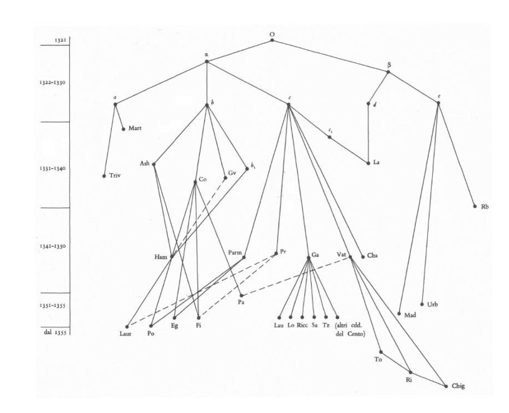
As explained by Fabio Zinelli, the enormous amount of transmitted Comedy manuscripts and the lack of an autograph make reconstructing its textual tradition a highly complex question (68). Currently, the most influential and well-accepted is the critical edition by Petrocchi in the late 1960s. It is a reconstructive edition based on 24 Comedy manuscripts dated before 1355, for Petrocchi determines that due to the copying and circulation activities done by Boccaccio, the textual transmission of the Comedy becomes too contaminated beyond the possibility of a comprehensive and coherent survey (Shaw, 50–52). Petrocchi manages to reconstruct a stemma codicum to represent the relations between all 24 foundational manuscripts (Figure 40). The manuscripts are divided into two major branches: branch α is of Tuscan or Florentine origin, whereas branch β consists of manuscripts coming from a northern tradition (qtd. in Zinelli 68). However, Petrocchi’s stemma is not uncontested. In her book on editorial matters accompanying her digitalised critical edition of the Comedy,[The edition is freely available at “Commedia: A Digital Edition”, https://www.dantecommedia.it/.] Prue Shaw gives a comprehensive overview of the debates and development surrounding the stemmatology of the Comedy, including several proposals of new stemmas (50–67). Despite all the debates around identifying key witnesses and reconstructing a genealogy of the Comedy manuscripts, as Zinelli observes, the proposed stemmas for Dante’s work generally have two principal branches (67). By and large, it is agreed among scholars that there is family α of manuscripts copied in Florence and the wider Tuscany, and another family β of manuscripts copied in Northern Italy as those are two major centres producing and disseminating Dante’s work at the time (Shaw, 102).
Taking into consideration the complexity and all the scholarly contentions, this section attempts to shed some light on any potential relations between MS. Canon. Ital. 108 and other extant manuscripts, while also serving as my personal first trial in stemmatology. The limited scope of this project means that it is impossible to examine even all the selected folios. Since Petrocchi’s critical edition remains the most accepted, referenced and readily available version today, an initial comparison is conducted between it and fols. 64r-72r to produce a compilation of around 45 significant textual variances, such as uses of different words and phrases that are not evidently scribal errors, or changes in word order that impact the connotation of the phrase or verse. Then, after closely consulting Petrocchi’s collation over the 24 early manuscripts, the compilation of significant textual variances is narrowed down to around 20 instances based on factors including how frequent similar variances occur, how variant it is, how many manuscripts are involved, and if there have been historical debates on the variance. Simultaneously referencing the 400 loci of important textual variances proposed by Barbi, Par. V (fols. 67v-68v) is selected to be the sample for this section, as it has the highest number of significant variances.
Based on Petrocchi’s collation, fols. 64r-72r share the most similarities with four manuscripts: Napoli, Biblioteca Oratoriana dei Girolamini, 4 20 (Fi); Parma, Biblioteca Palatina, Parmense 3285 (Parm); Cortona, Biblioteca Comunale e dell’Accademia Etrusca, 88 (Co); and Parigi, Bibliotheque Nationale, fonds italien 539 (Pr). Out of the 20 variances, the selected folios share around 7 textual variances with each of the four manuscripts. To give a sense of the relations between the five manuscripts, below is a collation of a few more significant places based on the loci identified by Barbi (MS. Canon. Ital. 108 is marked as A):
- v.34: ‘Tu se’ omai del maggior punto certo’
omai: A (ormai), Co Parm Fi Pr (omai)
del maggior punto: A (del magior ponto), Co (del maggior punto), Parm (delmaggio punto), Fi Pr (del|pʀimo punto) - v.36: ‘che par contra lo ver ch’i’ t’ho scoverto’
contra lo ver: A (contralouero), Co (c͡otrario), Parm (contraluer), Fi Pr (contra|louer)
ch’i’ t’ho: A Parm Fi Pr (chio), Co (chito)
scoverto: A Parm Fi Pr (ſcouerto), Co (ſcoꝑto) - v.88: ‘Lo suo tacere e ’l trasmutar sembiante’
Lo suo tacere: A (Loſo piacer), Co (Loſuo tacere), Parm (Loſuo tacer), Fi (Loſuo ptacere), Pr (Loſuo tacere) - v.95: ‘come nel lume di quel ciel si mise’
nel lume: A Co Parm (nel|lume), Fi Pr (nel|ſegno)
- v.111: ‘di più savere angosciosa carizia’
di più savere: A Co Pr (dipiu ſapere), Parm (dipiu ſauer), Fi (dipiu udier) - v.120: ‘di noi chiarirti, a tuo piacer ti sazia’
ti sazia: A (ſiſatia), Co Parm Fi Pr (tiſatia) - v.125: ‘nel proprio lume, e che de li occhi il traggi’
nel proprio lume: A (nel primo lume), Co (alproprio lume), Parm (del pʀopio lume), Fi (nel pʀopio lume), Pr (nel propio lume) - v.128: ‘anima degna, il grado de la spera’
anima degna: A Co Parm Pr (anima degna), Fi (beato ſpirito).
Excluding differences in spelling patterns and spacing, Par. V in MS. Canon. Ital. 108 seems to generally share textual relationships with Co, Par, Pr, and Fi. Occasionally, we see an isolated case of textual variances, which might imply the influence of another sub-branch of manuscripts.[Which could correspond to the hypothesis that a different and supposedly ‘better’ exemplar is identified and used during the production of the manuscript.] Returning to Petrocchi’s stemma, the four manuscripts belong to two different sub-branches, both under the α family, suggesting that the sampled canto likely aligns more with the Florentine or Tuscan tradition instead of the northern traditions. If we take this indication as representative of the entire manuscript (which is a bold assumption), then it seems to contradict the attribution to the Lombardo-Venetian tradition identified by scholars like Moore – a tradition that falls under family β of the northern manuscripts (Mecca 167). Moreover, the northern manuscripts show ‘a resistance to the spread of textual innovation from Tuscany’ and are less contaminated by the alterations commonly found in family α (Shaw, 102). Yet this does not mean that the northern traditions are highly isolated from the Florentine and Tuscan traditions. We must not forget that, as shown by Petrocchi’s stemma (Figure 40), there are substantial overlaps between families α and β. Manuscripts are constantly being disseminated at the time, especially from large productive centres like Florence. Textual alterations and innovations often occur first in these highly active production centres, then gradually progress towards the more peripheral locations, like the northern regions in this case, but do not always reach them; this is why the periphery tends to be ‘more conservative’ with less textual innovations (Shaw, 102). It is thus entirely possible that a Florentine or Tuscan copy was transmitted to the Lombardo-Venetian regions and became one of the exemplars there. This would explain why the running text of our manuscript aligns largely with the α family but also contains characteristics of the Lombardo-Venetian tradition.
Nonetheless, there is no doubt that MS. Canon. Ital.108 is a well-produced copy of the Comedy based on a ‘very good foundation text’ (Moore 517), despite the amount of errors and peculiarities present as well as the editorial liberty taken by the scribes involved in the collective production process. A more comprehensive survey of the textual relations between MS. Canon. Ital. 108 and a selected number of key witnesses, such as one that examines all 400 loci identified by Barbi, should provide a much more solid foundation for hypothesising about the textual traditions it engages in.
Transcription Sample
In alignment with the highly diplomatic approach, several transcription decisions are made during the process, for example: 1) all original spacing and blank spaces are retained; 2) all abbreviations, spellings and word orders are retained, including errors; 3) letters with multiple allographs are differentiated by employing Unicode characters that visually correspond to how they are written, e.g., ƞ-n, ɱ-m, ʀ-r and ſ-s. All accents and other decorative diacritics are not transcribed for better legibility, and the digitised version will direct readers to consult the manuscript. In-line edits of a different hand are transcribed in grey and italicised.
Below is a shortened sample of the transcription (fol. 64r):
I ncipit tercia comedia paradiꭙus que diuidi
tur in ꭙꭙꭙiii cͣ. S3 in hoc pͦ ·cͦa facit pʀoemi͠u et
eten͠o qu͠e om͡e tredit naatuãl’r ad bonu͠ ſineɱ
[‘Incipit tercia comedia paradisus que dividi / tu in XXXIII cantica Sed in hoc primo canticur facit proemium et / eterno ome tredit naturalitur ad bonum finem’.]
Lagloria decolui chetuto muoue
per luniuerſo penetra eriſpiente
inuna parte piu emeno altroue
nel ciel che piu dela ſua luce pʀ͠ede [i.e., prende.]
fuio euidi coſſe che redire
neſa nepuo qual delagui diſende
perche apʀeſanto ſe alſuo deſire
noſtro intelento ſipʀofonda tanto
che dietro lamemoʀia non po ire
Ueramentre quanno del regno ſanto
nella mia mente puote far teſauro
ſara oʀa matera del mio canto
Sample of Encoded Text
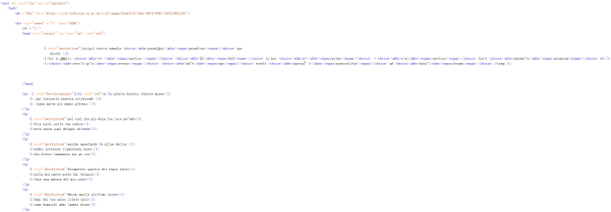
Below (Figure 41) is a sample of how the text is encoded (from the rubric to Par. I, 42) for the development of the digital edition. The TEI encoding template is developed based on the published digital edition of Pur. I-XI by Katie Bastiman and Holly Abrahamson.
Bibliography
Manuscripts
Cortona, Biblioteca Comunale e dell’Accademia Etrusca, 88. https://www.danteonline.it/vedimanoscritti/?manuscript=manoscrittiimmagini/88. Accessed 2 Apr. 2026.
Napoli, Biblioteca Oratoriana dei Girolamini, 4 20 (CF 2.16). https://www.dante.unina.it/idp/public/preview/mirador/idms/263308. Accessed 2 Apr. 2026.
Parigi, Bibliothèque Nationale, fonds italien 539. https://gallica.bnf.fr/ark:/12148/btv1b52507451s. Accessed 2 Apr. 2026.
Parma, Biblioteca Palatina, Parmense 3285. https://www.danteonline.it/vedimanoscritti/?manuscript=manoscrittiimmagini/Parmense_3285. Accessed 2 Apr. 2026.
Oxford, Bodleian Library MS. Canon. Ital. 108. https://digital.bodleian.ox.ac.uk/objects/b22739d8-d9c1-40f7-915a-8c1ce22f5a43/. Accessed 2 Apr. 2026.
Primary Literature (including critical and digital editions)
Dante Alighieri. La Commedia secondo l’antica vulgata. Edited by Giorgio Petrocchi, A. Mondadori, 1966. Le Opere di Dante Alighieri : edizione nazionale / Società dantesca italiana 7.
—, Commedia. Edited by Prue Shaw. A digital edition jointly published by Inkless Editions (Saskatoon) and the Fondazione Ezio Franceschini (Firenze), 2021. https://www.dantecommedia.it/index.html?view=copyright. Accessed 12 Apr. 2026.
‘Digital Dante Edition with Commento Baroliniano’. Columbia University Libraries. https://digitaldante.columbia.edu/. Accessed 2 Apr. 2026.
‘The Dartmouth Dante Project’. Edited by Robert Hollander et al., Dartmouth College, https://dante.dartmouth.edu. Accessed 2 Apr. 2026.
Secondary Literature
Alexander, J. J. G., and Otto Pächt. Illuminated Manuscripts in the Bodleian Library, Oxford. Clarendon P., 1966. HathiTrust, https://catalog.hathitrust.org/Record/000468709.
Barbi, Michele. ‘Canone Di Luoghi Scelti per Lo Spoglio Dei Mss. Della Divina Commedia’. Bullettino Della Società Dantesca Italiana, 1891, pp. 28–38.
Ceccherini, Irene. ‘Le corsive italiane tra 1270 circa e 1350 circa. cancelleresca e mercantesca’. De la herencia romana a la procesal castellana. Diez siglos de cursividad. Actas del IV Encuentro Internacional del Seminario Permanente ‘Escrituras cursivas’, Editorial Universidad de Sevilla, 2018, pp. 175–89. flore.unifi.it, https://flore.unifi.it/handle/2158/1147279.
———. ‘Teaching, Function and Social Diffusion of Writing in Thirteenth- and Fourteenth-Century Florence’. Teaching Writing, Learning to Write, 2010, pp. 177–92.
Derolez, Albert. The Palaeography of Gothic Manuscript Books: From the Twelfth to the Early Sixteenth Century. University Press, 2003. Cambridge Studies in Palaeography and Codicology 9.
Freccero, John. Dante: The Poetics of Conversion. With Rachel Jacoff, Harvard University Press, 1986.
Lansing, Richard, editor. Dante Encyclopedia. Taylor & Francis Group, 2000. ProQuest Ebook Central, http://ebookcentral.proquest.com/lib/oxford/detail.action?docID=574583.
Mecca, Angelo Eugenio. ‘La tradizione manoscritta della “Commedia”. Un percorso nella Biblioteca Trivulziana, con un’appendice sulla tradizione lombardo-veneta (σ)’. Libri & documenti, 40/41 (2014/2015), pp. 153–176, 2015, http://id.sbn.it/bid/RT10084067, p. 40/41 (2014/2015), t.2, pp. 153–76.
Mitchell, J. B. ‘Trevisan and Soranzo: Some Canonici Manuscripts from Two Eighteenth-Century Venetian Collections’. The Bodleian Library Record, vol. 8, no. 3, Feb. 1969, pp. 125–35. liverpooluniversitypress.co.uk (Atypon), https://doi.org/10.3828/blr.1969.8.3.125.
Moore, Edward. Contributions to the Textual Criticism of the Divina Commedia: Including the Complete Collation throughout the Inferno of All the Mss. at Oxford and Cambridge. With Dante Alighieri, University Press, 1889.
Petrucci, Armando. Writers and Readers in Medieval Italy: Studies in the History of Written Culture. With Charles M. Radding, Yale University Press, 1995.
Shaw, Prue. Commedia: A Digital Edition. 2nd edn, Scholarly Digital Editions, 2021, https://www.dantecommedia.it/.
Zamponi, Stefano. ‘Late Gothic: Italy (XIVth–XVIth Centuries)’. The Oxford Handbook of Latin Palaeography, edited by Frank T. Coulson and Robert G. Babcock, Oxford University Press, 2020, p. 0. Silverchair, https://doi.org/10.1093/oxfordhb/9780195336948.013.77.
Zinelli, Fabio. ‘The Manuscript Tradition, or on Editing Dante’. The Oxford Handbook of Dante, edited by Manuele Gragnolati et al., Oxford University Press, 2021, pp. 63–78. Silverchair, https://doi.org/10.1093/oxfordhb/9780198820741.013.3.