When Prof. Lähnemann attended one of our seminars at the university of Würzburg the other day and told us about the Taylor Editions and the possibility to work on one of these edition projects as a part of an internship, I was instantly thrilled. As I had already spent a few months on an edition …
Category: Around Oxford
Posts about ongoing research in book history at Oxford.
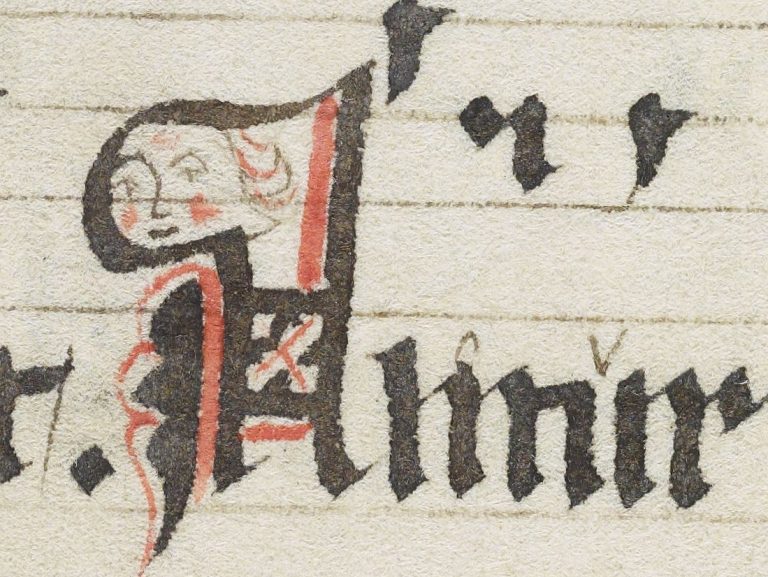
Teams Teaching Codicology. The Joy of Opening Manuscripts during Lockdown
Yesterday, in preparation for a Gregorian chant workshop and as part of the History of the Book show-and-tell sessions, Dr Andrew Dunning, R.W. Hunt Curator of Medieval Manuscripts at the Bodleian Library, University of Oxford, opened the Handbook of the Medingen Provost, Bodleian Library MS. Lat. liturg. e. 18. A full digitised copy is available, thanks to …
500 Years in the Making: Editing Luther’s De Libertate Christiana
Madeleine Ahern The Taylor Institution Library’s Latin copy of Martin Luther’s 1520 work On Christian Freedom (De Libertate Christiana) sits in the Special Collections storeroom on a rolling stack among an impressive selection of early modern printed texts from the Reformation. The text is identifiable by its shelfmark ARCH. 8o.G.1521.10 and its brown leather re-bound exterior with …
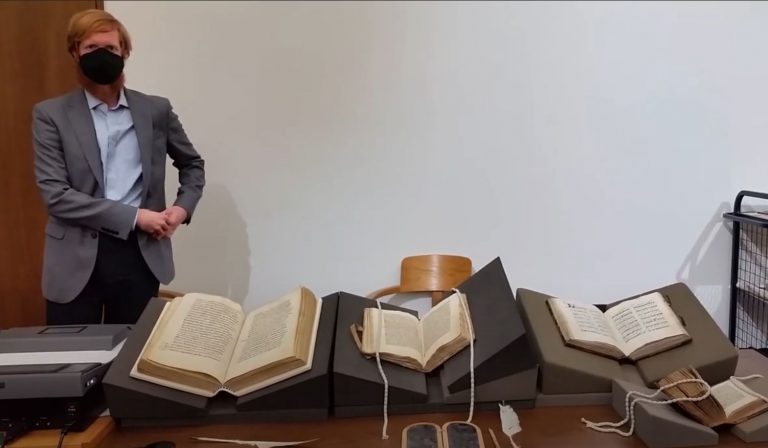
Show and Tell Manuscript Session in the Bodleian Library
Summary of a Show and Tell session for Henrike Lähnemann’s History of the Book students from the Faculty of Medieval and Modern Languages with Dr Andrew Dunning, R.W. Hunt Curator of Medieval Manuscripts at the Bodleian Library.

eLeUTHERia – Luther’s ‚Freiheitsschrift‘ as a Publishing Phenomenon
by Maximilian Krümpelmann Luther Demands ‘Freedom’ When Luther stumbled upon the word ‘eleutheria’ in October 1517 – Greek for ‘freedom’ or ‘liberty’ – he changed his name from ‘Luder’ to ‘Luther’.[1] This is more than a pun: the change anticipates the central role that the concept of ‘freedom’ would play in his writing and thinking, …

Call for Readers for 500 Years of Christian Freedom
This article was originally posted on the Taylor Reformation blog which has now become part of the Taylor Editions website with a dedicated Reformation Pamphlets series. Henrike Lähnemann In November 1520, Martin Luther published his pamphlet “On Christian Freedom” (Von der Freiheit eines Christenmenschen / De libertate christiana) which became the best-selling book of the 16th …

Interview with Richard Ovenden: Burning the Books for History of the Book
Lena Zlock (History of the Book and Modern Languages alumna and current DPhil in Education) interviewed Richard Ovenden, Bodley’s Librarian, about his latest work, Burning the Books: A History of Knowledge under Attack (Belknap Press, 2020)

Introducing the Method Option “Palaeography, History of the Book and Digital Humanities”
The combined workshops and seminars for the Palaeography, History of the Book and Digital Humanities provide training in dealing with manuscripts and books across different historical periods and European languages. The aim is to combine philological training with project work which takes seriously the material turn in Modern Languages and will enable students to do …

The Legacy of 500 years of “On Christian Freedom”
This article was originally posted on the Taylor Reformation blog which has now become part of the Taylor Editions website with a dedicated Reformation Pamphlets series. Henrike Lähnemann On 24 May 2020, I gave a short reflection on the legacy of 500 years of “On Christian Freedom” at Evensong in St Edmund Hall. It had been …
Translating the Spirit of Freedom
This article was originally posted on the Taylor Reformation blog which has now become part of the Taylor Editions website with a dedicated Reformation Pamphlets series. by Julia Bouquet When I first heard of Luther, I was in 4th grade. We had watched the film by Eric Till (2003) at school and I was so impressed …