Thursday 16th – Friday 17th July 2026
Room 2, Taylorian Institute, University of Oxford
St Giles’, Oxford, OX1 3NA directions
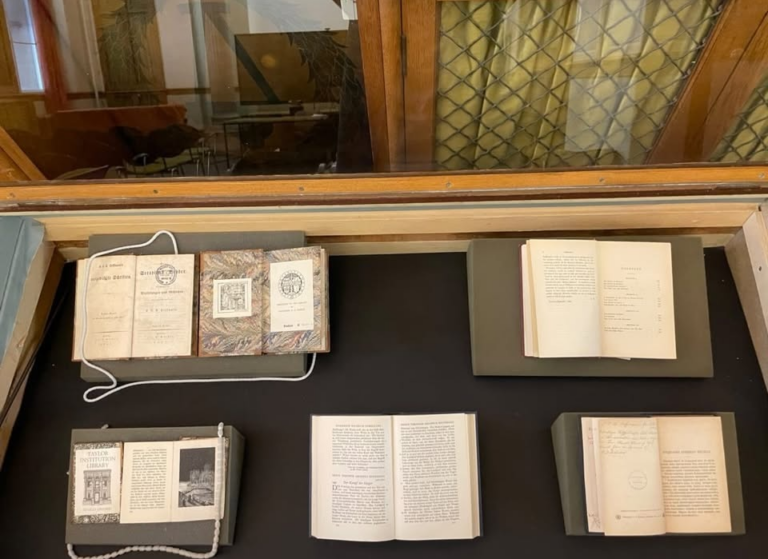
On the occasion of the two-day international conference ‘E. T. A. Hoffmann and Other Bodies’ organised Dr Joanna Neilly (University of Oxford) and Dr Eleoma Bodammer (University of Edinburgh) in the author’s 250th anniversary year.in Oxford, the cabinet exhibition highlights some of the holdings in the Taylor Institution Library, the Modern Languages Library for the university. The Taylorian opened in 1849 but Romantic literature was something of a blind spot in a collection with a strong historical interest, led by the Professor of Comparative Philology, Friedrich Max Müller. Interest in Hoffmann grew mainly during the era of the Professor Hermann G. Fiedler (1862–1945) who used literature as a form of cultural diplomacy. He also made sure that good English translations of German literature were in the library such as the first translation of the ‘Serapions-Brüder’ by Major Alex. Ewing in 1908. Colleagues in other European languages were also interested, such as William R. Morfill, the first Professor of Russian in Britain, who left a large collection of European Literature, among them a translation of ‘Kater Murr’, published in Petersburg in 1893. A bibliophile miniature edition of ‘Doge und Dogessa’ with lithographs was donated to the library by an alumnus. The exhibition was put together by Henrike Lähnemann, with Richard Morris (2nd-year German and French at Hertford) writing the captions.
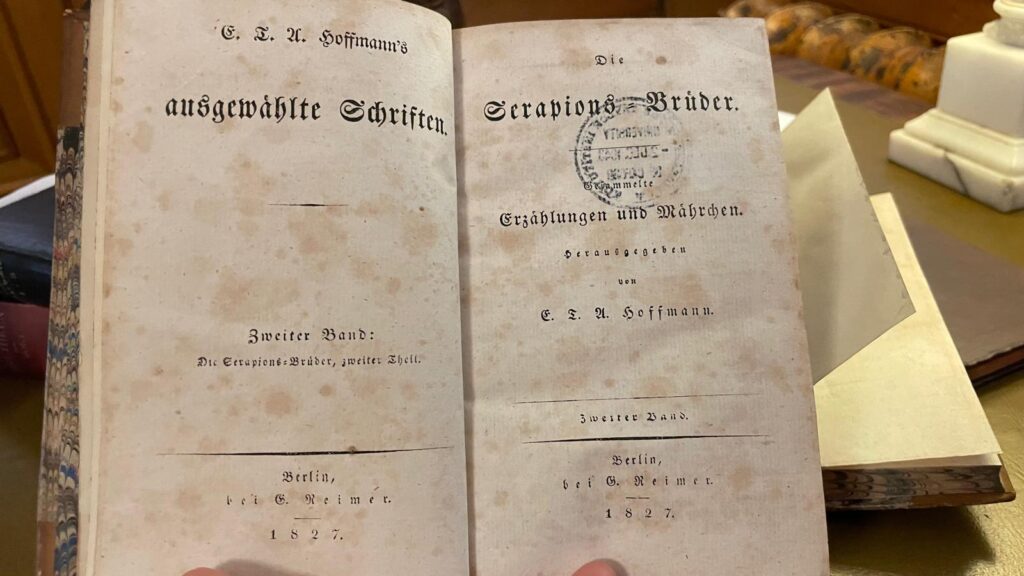
1827 Die Serapions-Brüder, Gesammelte Erzählungen und Märchen, herausgegeben von E. T. A. Hoffmann, Erster Band Berlin.
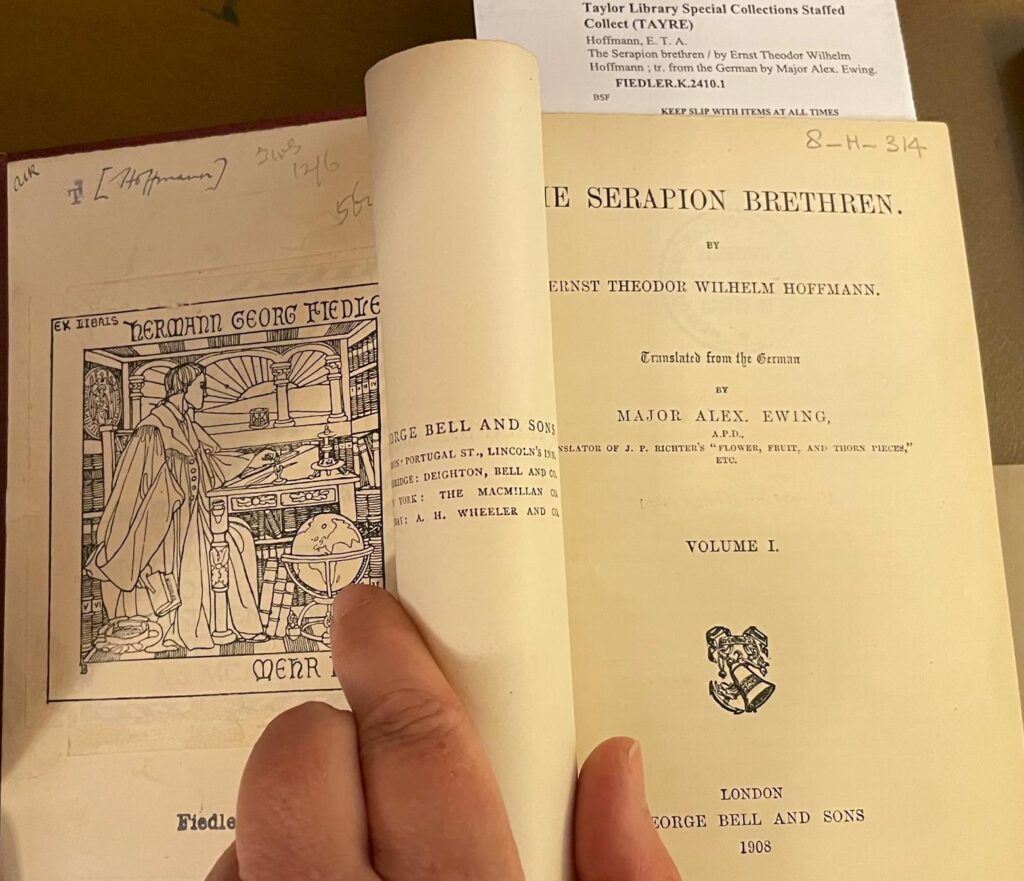
Published in 1827, shortly after E.T.A Hoffmann’s death in 1822, this is an early posthumous commemoration of Hoffmann’s works. Georg Andreas Reimer and E.T.A Hoffmann worked together extensively, with the majority of Hoffmann’s works published through Reimer, including the original four volumes of the collection between 1819 and 1821; the reprinting of these works may reflect their close, long-standing publishing relationship. These copies, in particular, once belonged to the library of the prominent German academic H.G. Fiedler in the early 20th century, who then donated them to the Taylor Institution. In the second volume, we see Fiedler’s bookplate, which depicts him as a scholar at a desk with Goethe’s last words on “mehr Licht”. Fiedler’s own legacy is admirable, and you may have seen his bust in the corridor as you walk into this room.
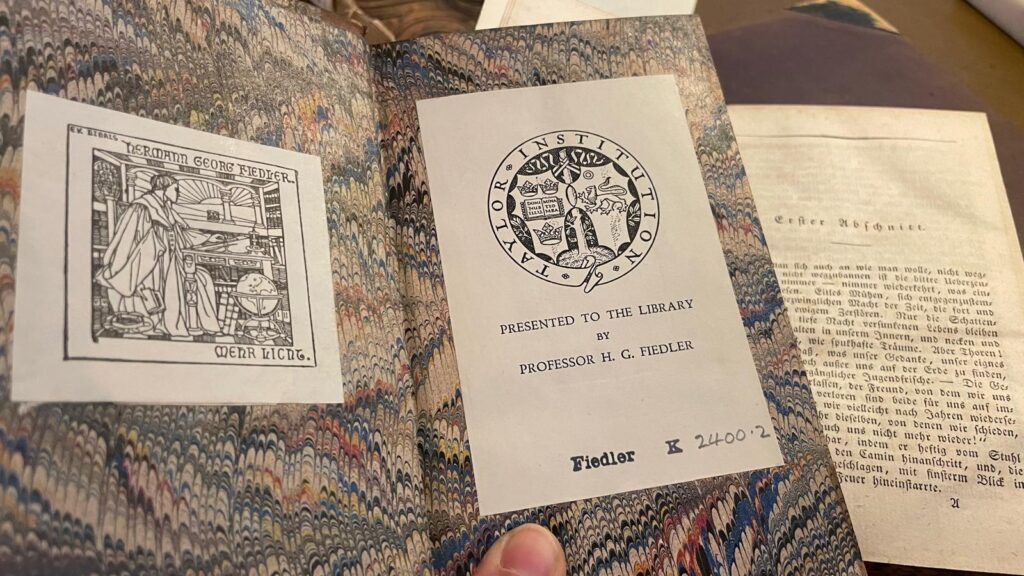
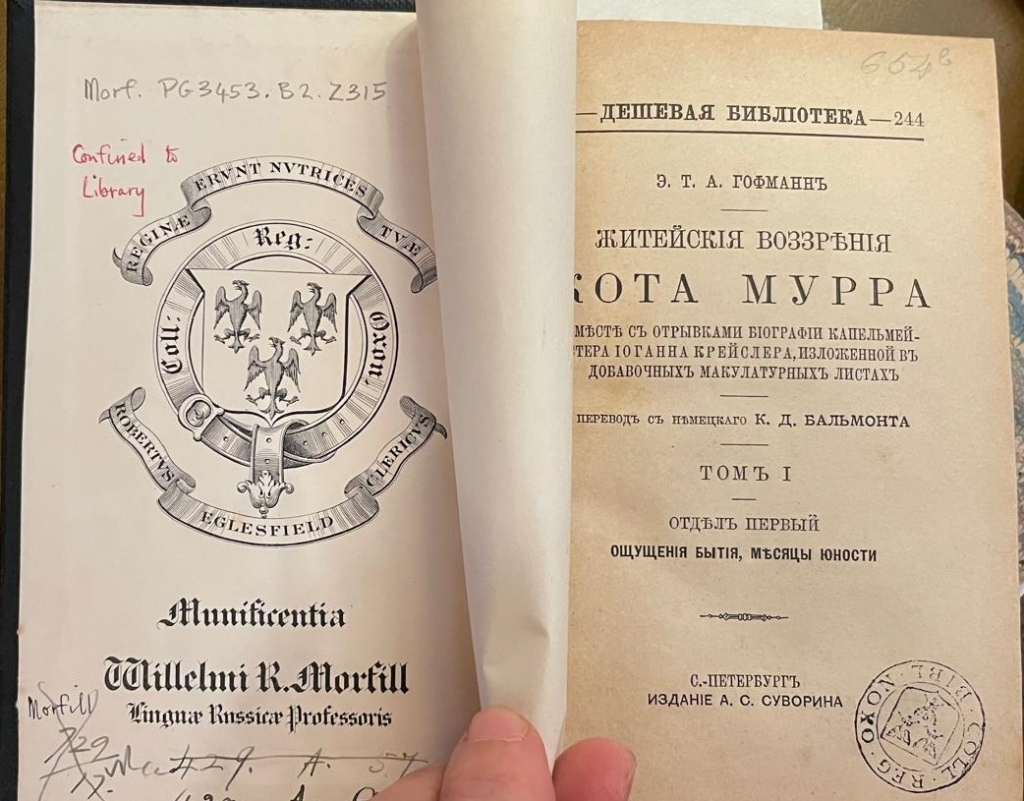
1893 E. T. A. Hoffmann, Zhiteĭskie vozzreniya kota Murra (Lebensansichten des Katers Murr), translated into Russian by Konstantin D. Balʹmont, St Petersburg.
This Russian copy of Lebensansichten des Katers Murr is on long-term loan from Queen’s College. We know from the half-title at the back of the book that it was part of a “deshevaya Biblioteka” (cheap or popular library) published by A.S. Suvorin, a series of literary classics intended for a large audience. The handwritten note on the left side records information about the book in Latinised Russian, German, and English, notably Hoffmann’s lifetime (1776-1822), titles in translation, and the name of the translator, K.D Balmont, a Symbolist poet and translator and one of the major figures of the Silver Age of Russian Poetry. The translation was published in 1893, the year after Tchaikovsky’s ballet debuted in St Petersburg, the same city where this book was published. This edition reflects Hoffmann’s enduring legacy and appreciation worldwide.
1908 Ernst Theodor Wilhelm Hoffmann, The Serapion Brethren, translated from the German by Major Alex[ander] Ewing, vol. 1, London. Taylor Institution Library: Fiedler.K.2410.1.
Named after Hoffmann’s literary and social circle, Die Serapionsbrüder, the Serapion Brethren is a four-volume collection of Hoffmann’s novellas and fairy tales composed between 1819 and 1821. The first complete translation of the collection was published only in 1886, and this edition was a reprint of the first volume, published in 1908. As Ewing notes in his preface to the collection, most of Hoffmann’s works had been reproduced in English, removed from the context of the wider collections. Ewing’s musical background, having studied German and Music at the University of Heidelberg, is reflected in his enthusiasm for Hoffmann’s works; he is particularly interested in Hoffmann’s views on musical subjects, as we can see at the end of his preface on the left.
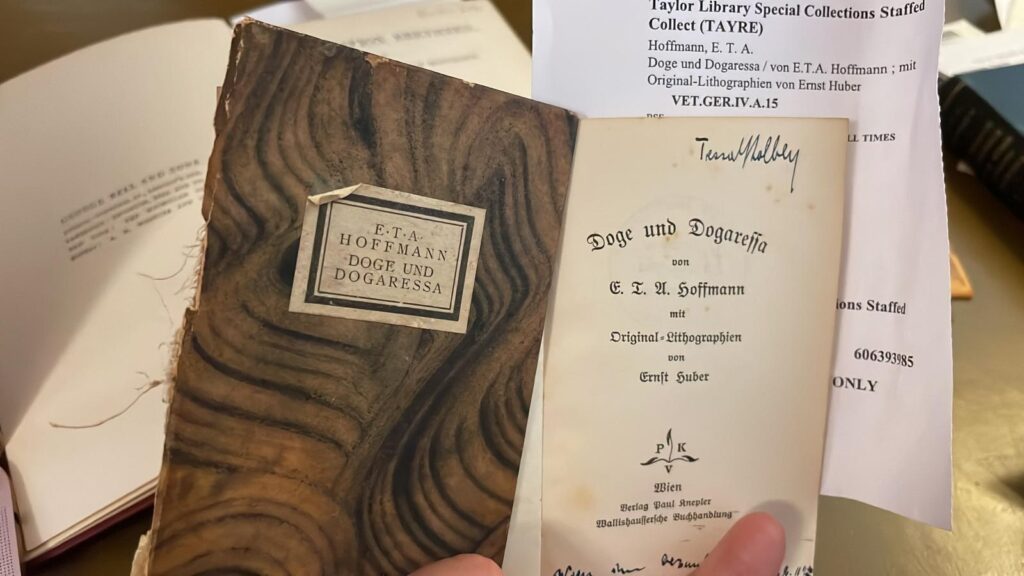
[ca. 1920?] Ernst Theodor Amadeus Hoffmann, Doge und Dogaressa, with original lithographs by Ernst Huber, Vienna.
This small pocketbook is of the 1818 novella Doge und Dogaressa by E.T.A. Hoffmann, somewhat inspired by the oil painting “Doge and Dogaresse” by Carl Wilhelm Kolbe. In the title page of this copy, there is a handwritten note of the place it was bought, Vienna, and a dedication to the evenings spent there. Although the binding has deteriorated, the illustrations by Ernst Huber are clear and display important moments from the narrative. On the right is an illustration of the Venetian skyline lit up at night. The sea in Venice plays a highly important role in the text, especially in the denouement, where this illustration comes from, in which the two lovers, Antonio and Annunziata, are ultimately pulled under the waves as they embrace.
1943 Das Oxforder Buch Deutscher Prosa von Luther bis Rilke, herausgegeben von H. G. Fiedler, Oxford. Taylor Institution Library: Fiedler.P.271.
A companion to his 1911 Das Oxforder Buch Deutscher Dichtung, H.G Fiedler published this collection in the midst of World War II, showing his continued determination even after retirement to present German literature to an English readership and continuing cultural dialogue that was under intense stress. Both collections attempt to show a historical perspective of German writing, with prose spanning from Martin Luther to Rainer Maria Rilke. The exemplar Fiedler chose from Hoffmann’s works is Der Kampf der Sänger, known for its approach to medieval aesthetics, which went on to inspire other works such as Wagner’s Tannhäuser.
Conference ‘E. T. A. Hoffmann and Other Bodies‘
The conference ‘E. T. A. Hoffmann and Other Bodies’ has received generous funding from the University of Oxford’s John Fell Fund, St Peter’s College John O’Connor Fund, the Modern Humanities Research Association, the E. T. A. Hoffmann-Gesellschaft Bamberg, the English Goethe Society, and the Association for German Studies UK and Ireland. This event ignites novel inquiries into Hoffmann’s pioneering literary examination of the body and his engagement with scientific discourses such as artificial life, the embodied brain, and animal magnetism. The conference has attracted established academics and early career scholars from the UK, Ireland, India, the USA, and across Europe to present papers on diverse themes including automata, virtual reality, childhood development, petrification, aesthetics of the body, pregnancy and maternity, queerness and otherness, disability and artistic practice, and the relationship between mind and body.
THURSDAY 16TH JULY
10.30 onwards:Registration, tea and coffee
11.00 Opening and Welcome: Dr Joanna Neilly (University of Oxford) and Dr Eleoma Bodammer (University of Edinburgh)
11.15 Prof. Dr. Bettina Wagner, President of the E. T. A. Hoffmann-Gesellschaft, Bamberg, ‘The E. T. A. Hoffmann-Gesellschaft in 2026’
11.30-12.30 Panel 1: Automata and Artificial Intelligence
Chair: Dr Joanna Neilly (University of Oxford)
Rainer Lewandowski (former artistic director of the E. T. A. Hoffmann Theatre, Bamberg), ‘E. T. A. Hoffmann. Automaten, Puppen und Getier: Phantasie und Technik’
Dr Sahib Kapoor (Jawaharlal Nehru University, New Delhi), ‘“Olimpia und Ich?” Hoffmann’s Olimpia and her Representation in Visual Arts’
1.45-3.15 Panel 2: Childhood Development and Embodied Learning
Chair: Dr Eleoma Bodammer (University of Edinburgh)
Prof. Holly Blackford Humes (Rutgers University), ‘Childhood Toys: Embodiment in Media and Performing Objects’
Dr Elizabeth Ramsey (University of Cambridge), ‘“[N]ichtsnütziges Zeug”: Hoffmann’s “Das fremde Kind” and the Robotic Body as the Site of Anxiety about Education and the Human’
Dr Joanna Neilly (University of Oxford), ‘Usurping Maternity in Hoffmann’s Nachtstücke’
3.30-4.30 Panel 3: The Petrified Corpse, in History and in Fiction
Chair: Dr Joanna Raisbeck (University College London)
Prof. Ritchie Robertson (University of Oxford), ‘From Fet-Matts to Elis Fröbom: The Mummified Body in “Die Bergwerke zu Falun”’
Dr Stephanie Großmann (Universität Passau), ‘Vom Erzählen zur Bühne: Alchemie und Verkörperung in “Die Bergwerke zu Falun” (Hoffmann 1819; Hofmannsthal 1899; Wieler 2021)’
4.45 ‘The Hoffmann Experience—Embodied Storytelling in Virtual Environments’. Led by Svenja Hahn (Ludwig-Maximilians-Universität München)
Followed by: Drinks reception in the Main Hall, sponsored by the English Goethe Society.
FRIDAY 17TH JULY
9.45-11.15 Panel 4: Aesthetics of the Body: Intermediality and Form
Chair: Dr Eleoma Bodammer (University of Edinburgh)
Prof. Ricarda Schmidt (University of Exeter), ‘Hoffmanns Körperdarstellungen, Commedia dell’arte und Raffael’
Agathe Duperron (Universität Heidelberg), ‘Körper zwischen Literatur und bildender Kunst in der Erzählung “Die Abenteuer der Sylvester-Nacht”’
Prof. Dr. Ulrich Kinzel (Universität Kiel), ‘Carnival of Bodies: Hoffmann’s Die Elixiere des Teufels’
11.30-1.00 Panel 5: Marginalised Bodies
Chair: Dr Joanna Neilly (University of Oxford)
Bogdan Burghelea (Humboldt Universität zu Berlin), ‘Heavenly Body: Queerness and Otherness in Hoffmann’s Fairytale “Das fremde Kind”’
Prof. Ute Weidenhiller (Roma Tre University), “Die Gelüste der schwangeren Frauen”. Mütterliches ‘Versehen’ und die Genealogie des Verbrechens in E.T.A. Hoffmanns Das Fräulein von Scuderi
Dr Polly Dickson (Durham University), ‘Working Through Pregnancy in “Rat Krespel”’
2.15-3.45 Panel 6: Disability and Artistic Practice
Chair: Dr Polly Dickson (Durham University)
Dr Eleoma Bodammer (University of Edinburgh), ‘The Disabled Gaze and Creative Rehabilitation in Hoffmann’s “Des Vetters Eckfenster”’
Dr Jasmin Köhler (Universität Vechta), ‘Die Poetologie einer “Dis/ability to See” in Hoffmanns “Des Vetters Eckfenster”’
Dr. Dr. Bernd Hesse and Jörg Petzel, ‘Die Körperlichkeit der Titelfigur “Klein Zaches genannt Zinnober”’
4.00-5.00 Panel 7: The Mind and the Body
Chair: Prof. Ritchie Robertson (University of Oxford)
Prof. Christa Spreizer (Queens College, CUNY), ‘The Imperfectly Embodied Present of “The Sandman”.’
Prof. Jürgen Barkhoff (Trinity College Dublin), ‘Animal Magnetism in Kater Murr’
The organisers would like to acknowledge the generous support of the following:
- University of Oxford John Fell Fund
- St Peter’s College Oxford John O’Connor Fund
- University of Oxford Faculty of Medieval and Modern Languages
- The Modern Humanities Research Association
- The E. T. A. Hoffmann-Gesellschaft
- The English Goethe Society
- Association for German Studies in Great Britain and Ireland
We would also like to extend a special thanks to Dr Alexandra Hertlein and Martin Lindner for their invaluable assistance in the running of this conference.