Ingeborg Bachmann, Fragmented. A New Translation of Selected Todesarten Texts. Translated by an Oxford Student Collective. Edited by Isabel Parkinson. Treasures of the Taylorian: Series Two: Writers in Residence, Volume 6. Series Editor: Henrike Lähnemann. Taylor Institution Library, Oxford, 2026. Read the open access pdf version of the book, buy it online, and see other publications in the Taylor Editions series.
Editor’s Introduction (Isabel Parkinson)
We wanted to end in madness and joy. Onward. Onward. They thought.
One hundred years since her birth in Austria, and a little over fifty since her death in Rome, Ingeborg Bachmann is still one of the most celebrated German-language writers. She turned to writing after completing her doctorate at the University of Vienna, producing radio plays, poems, prose, and libretti, and winning, throughout her career, the Gruppe 47 and Georg Büchner literary prizes, among others.
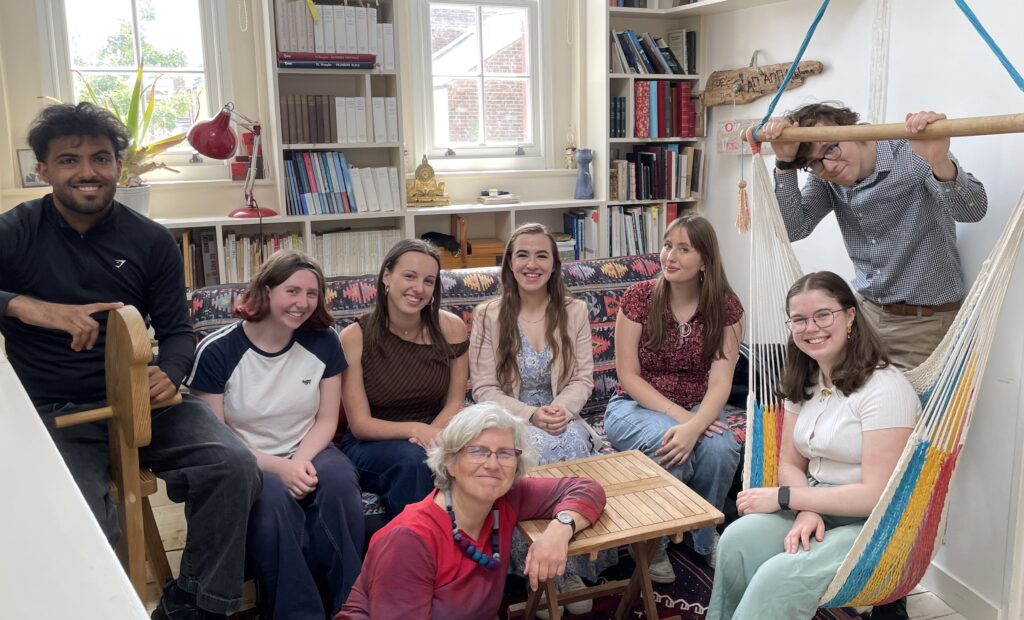
This volume, Fragmented, presents a collection of previously untranslated drafts of Bachmann’s work. These drafts are from unfinished stories, or are pieces cut out from works as they approached their final forms, and are grouped into four fragments: Eugen-Roman I; Ein Ort für Zufälle: Paralipomenon; Geschichte(n) einer Liebe; and Eugen-Roman II. This translation has been carried out by six undergraduates studying German at Oxford: Elizabeth Dallosso, Sam Edwards, Anwen Jones, Anna Standish, Sophie Stewart, Adesh Takhar, and edited by Oxford lecturer Isabel Parkinson.
Bachmann had intended to complete a significant cycle of novels entitled Todesarten. The fragments comprising what would have been the Todesarten are vast, and have a complex genesis – they have been meticulously ordered and presented by editors Albrecht and Göttsche, from whose editions we have drawn the texts for translation.
The drafts are rich with characteristically Bachmann themes of inwardness, history, memory, and illness, and she herself introduced the works of the Todesarten as, variously, ‘die Reise durch eine Krankheit’ [‘the journey through an illness’] and ‘ein Kompendium der Verbrechen’ [‘a compendium of crime’] (Todesarten’-Projekt,ed. by Monika Albrecht and Dirk Göttsche, 4 vols (Munich: Piper, 1995), II, p. 360 & 361). Only one of these novels (Malina, intended to be the first) was complete at the time of her death.
“The great STORY that no one has yet told because the ballads, wars, inventions, and everything else worth noting coalesce into what goes unnoticed, from things that are nothings, from the factual, the totality of facts.”
Undertaking a significant project like this represented a deviation (though by no means a unique one) from the usual pattern of undergraduate translation teaching, with students having to dwell on a long-term, consistent strategy, as well as how to communicate their process in the finished volume, in a way not needed when working on shorter texts in isolation. Tackling a whole work, even one composed of fragments such as this, allowed us to immerse ourselves in a distinct voice for long stretches at a time.
Even in the meticulousness of Ingeborg Bachmann’s works, there is a rushing, an onwardness. Her only completed novel Malina is set entirely in ‘heute’, ‘today’ – and her final published work is entitled Simultan. In Fragmented, we roam through dreams, going away and coming home, train rides, a steeplechasing, springing, plummeting journey. ‘Weiter’, ‘onward’ or ‘further’, appears twenty-three times. And yet this project allowed us the privilege of slowing down, of rediscovering the human in translation, of imagining, laughing, bickering, of writing and re-writing, scrapping, and finally settling, a process of which Bachmann’s own drafts are also suggestive.
The student translators quickly decided to work in a truly collaborative way, producing a draft individual translation of each fragment as a way of engaging closely with the source text, and then working in real time to find the mutually favoured solution. This was unanimously preferred over dividing the text into segments, with each translator taking charge of one portion. The finished result, then, is not so much a stitched-together patchwork of different styles, but a potion, a cocktail, of distinct voices. The students have taken pride not only in their finished work, but in their spirited, independent, detail-oriented approach. Linguistically, no stone has been left unturned, and no word has been allowed to fall into the finished text by accident.
“To bring forward such a matter, so insignificant as love, to write her story and then to leave it behind completely, that’s fine. But what is this thing we call a love, a passion?”
This project has served as a refreshing reminder of what is foregrounded when translating entirely as, in, and from a human mind. Part of the question which I and the translators asked ourselves was what we discover about the original texts precisely by re-ordering and translating them, especially in translating different versions of the same text. For this reason we preserved the four different versions of the ‘Geschichte / Prozeß einer Liebe’ fragments in their entirety. Students tackled these in teams, but in isolation from one another – the result is a coherent chorus that nonetheless shifts between versions of the story, seeking the creative possibilities that open up and the moods created by different English formulations even when working with the exact same source material.
The selection and order of texts here does not intend to pick out a plot or to tell a new story, nor represent a definitive interpretation. A story and a structure of some sort do emerge from the fragments represented here, but it is not the task of this volume to claim that this is ‘what Bachmann meant’. Instead, its purpose is to allow our own minds to enter into and participate in the text, as readers, thinkers, and translators – and, of course, to offer more Anglophone readers the chance to encounter Bachmann. It is a testament to the wide-ranging topics of her works, to her characteristic voice, and her absorbing narrative threads, that they can be slotted together in a new order and open up fresh resonances.
Translators’ Notes (Elizabeth Dallosso, Sam Edwards, Anwen Jones, Anna Standish, Sophie Stewart, Adesh Takhar)
Previously, in the core translation module, we have been translating short passages similar to what we might get in the exam. To translate for the Taylorian Editions Writers in Residence series has been a very different experience that has come with a variety of new challenges.
Part of the challenge lay in Bachmann’s unique style. Her writing is subtle, and she often relies on connotations of language to convey her ideas. Finding English words that have both a similar meaning and similar connotations to the German original posed difficulties. An example of such difficulty, and the limitations of translation, can be seen in the translation of the titles within the third extract, which consists of multiple versions of the same set of events, and which prompted debates as to whether to stick closely to the German originals or to take more creative liberty with them. Having only briefly encountered Bachmann’s works before, we also found ourselves in the unusual position of only viewing her writing through the specific lens of translating it.
The fragments gave us a welcome opportunity to explore and enjoy translation in a more creative and experimental manner. Our emphasis remained very centrally on collaboration throughout the whole process, ensuring every sentence had multiple voices and interpretations. We learnt how to approach these conversations productively, and it was often the most debated sections of the texts which produced the most satisfying resolutions for everyone involved. What surprised us about the project is how our translation has been changing and evolving consistently from the start. As our understanding of Bachmann’s writing grew, our translations became more flexible and we were able to be more creative with our decisions. In a world increasingly relying on AI translation as a quick, convenient, cheaper method of translation, projects such as this are essential in preserving the importance of first-hand translation – and indeed, no GenAI was used in the production of this translation.
Knowing that this project will be published makes all the hard work we’ve put into this, hours spent debating individual words, staring at a screen trying to figure out what Bachmann meant, and reading around the text, incredibly worth it. It has also changed the way we’ve viewed the project: rather than trying to translate as quickly as possible with little external help, as we would for exam practice translations, we have exhausted the resources at hand because we all want the translation to be as good as it can be. Having a clear end goal has been really exciting, and we cannot wait to get a copy of the published work.
“But this language barrier which lay between us was at the same time also a playing field of hope, which wouldn’t have existed had we shared the same language and been capable of judging each other.
“Two languages that want to be spoken as though they were a single one …”
Artist’s Impressions (Emily Dicker)
Following on from my work as both illustrator and translator on The Woman You Become (2025), I was very excited to be part of another Taylor Editions publication – this time from Bamberg, Germany, where I am currently finishing my year abroad. Although I had never read any Ingeborg Bachmann before working on the illustrations for Fragmented: A New Translation of Selected Unfinished Todesarten Texts, her work has long been on my TBR list. So this felt like the perfect introduction!
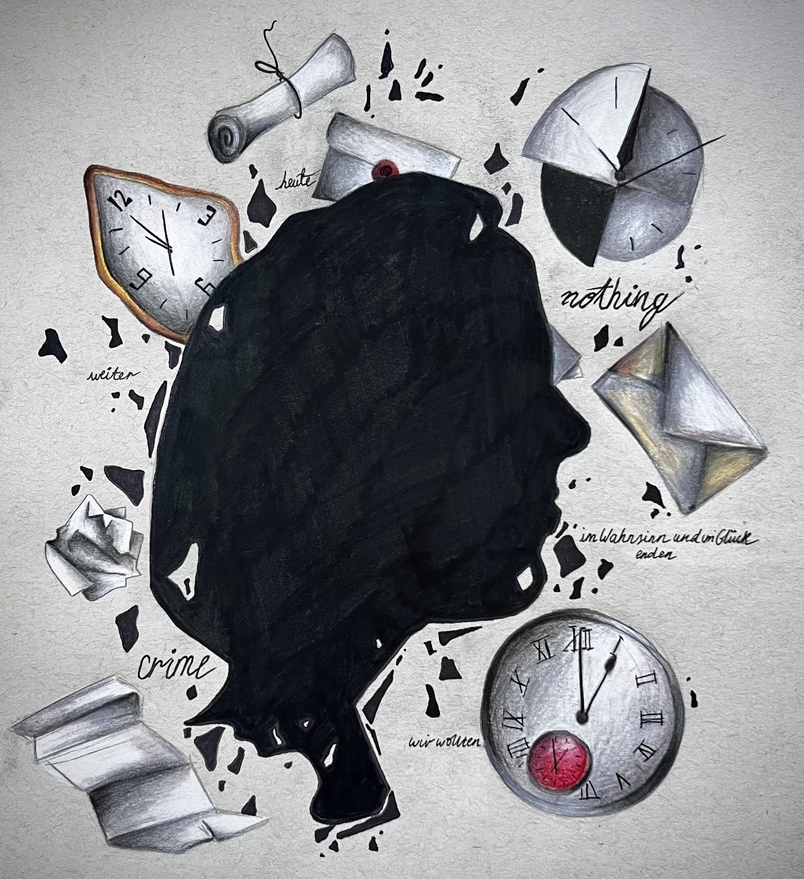
As soon as I began to read extracts from the original texts and drafts of the translation, the words transformed into images in my head. My mind was filled with splinters of clock faces, scraps of paper, and fragments of handwritten text and I immediately set pencil to paper to sketch out my initial ideas. An introductory meeting with editor Isabel Parkinson confirmed my initial response to the text and I finalised my design: a shadowy side profile of Bachmann’s face, splintering off into fragments of letters and writing implements, as well as key words and phrases from both the German and English texts. Isabel’s description of Bachmann as simultaneously “socially magnetic” and “very private, quite inward” was particularly formative for my final design, in which I hope to visually represent these “twin forces of outward-facing energy and a lively inner life”. The fragmented side-profile should demonstrate an externalisation of Bachmann’s internal vibrancy, which bubbled through the author’s subconscious, into her work, and out into the world beyond, without compromising her own personal privacy.
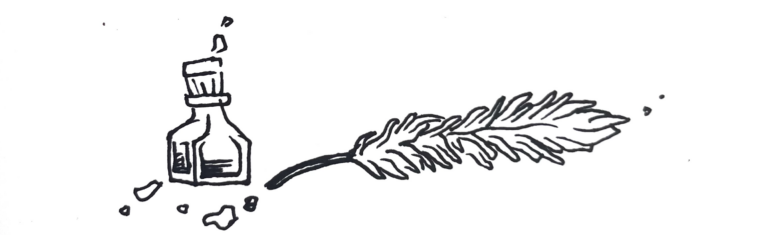
It was wonderful to watch the translators’ reactions upon seeing the design for the first time, and the subsequent discussion with them provided me with more ideas for intratextual illustrations. I greatly appreciated their input, given their back-to-front-and-inside-out knowledge of the text! Using their ideas, I created a series of smaller ink sketches in the same fragmented style of the cover, to be sprinkled throughout the text in order to add yet another element of translation to the text – I have always considered translation to be a process which occurs not only between languages, but between words and images too.
Many thanks to all the translators and Isabel Parkinson for trusting me with my vision and to Henrike Lähnemann and Emma Huber for their support on this exciting new project.